Dec 3, 2025, 15:18 PM
by
Catherine Lees
The process of cleaning tanks and vessels that contained flammable materials is a risky business. As tanks will be empty when the cleaning process is undertaken, the potential for explosive vapours or dusts to be present is increased
during the cleaning process. A petroleum tank that is empty is far more of an explosion risk than one that is full. This fact is well understood, particularly in the marine industry.

Mechanically Generated Impact and Friction Sparks
Any moving parts could potentially act as these types of friction source if the forces in play are enough. For fluid-powered rotary tank cleaners operating at low pressures (sub 4 bar), the forces in play are unlikely to pose any risk of friction and
sparking. Nevertheless, the machine in question will need to be designed and inspected to ensure that all sensible precautions have been taken to mitigate this small risk. For higher-pressure fluid-driven tank washers and for motor-powered tank washers,
the risk is significantly higher.
With tank cleaning heads that are entirely fluid-powered, the risk is far less simply because they automatically have some fail-safes built in. The only potential source of impact or mechanical sparks would be a failure in the gearing system causing frictional
heat build-up or an impact between two parts of the machine that would not normally make contact. In either case, a fluid-powered tank washer would almost certainly stop working and rotating very quickly, thus automatically removing the explosion
risk. This is not the case in motor-powered tank cleaners, so additional safety features such as a fail-safe motor cut-off system will need to be put in place by the manufacturer.
Electrical Sparks
These would only apply to motor-powered tank cleaners. Often this risk will be mitigated as the motor will sit outside the explosive environment. Any powered tank cleaner will always need to have sufficiently redundant safety features to ensure it remains
fully earthed. For Zone 0 environments, this will mean having doubly redundant safety features such that even if one fails, the machine can continue to operate safely.
Background
Three large explosions during the cleaning of crude oil tankers in 1969 prompted significant research into the safety of tank cleaning operations. The conclusions were that the explosions were likely caused by the tank cleaning system itself rather than
some other external ignition source. This prompted further research into making tank cleaning systems safe for use in explosive environments. The results of this investigation highlighted some perhaps unexpected sources of explosion risk and have
underpinned much of the ATEX design compliance recommendations found today.
Potential Sources of Risk
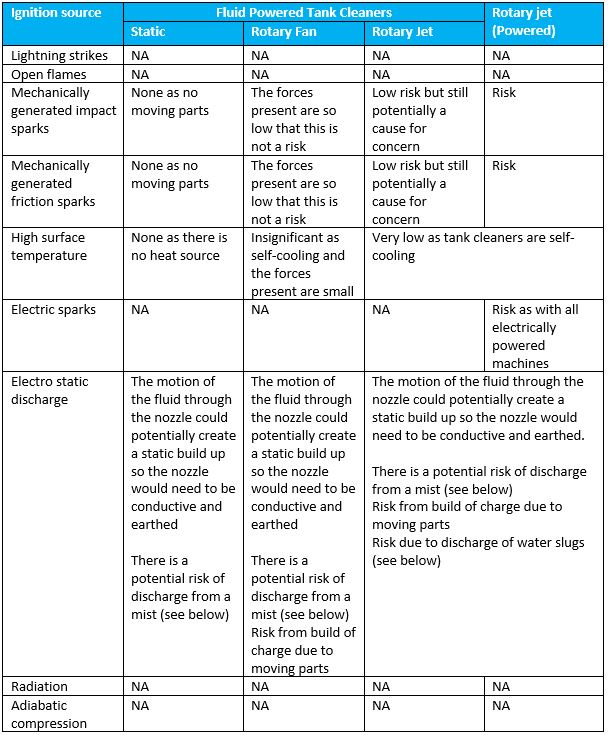
The ATEX directive in general identifies nine potential sources of ignition. Not all are relevant to tank cleaning systems and some are relevant to only certain types of tank cleaner. Whilst there are many models of tank cleaning equipment on the market,
they can all be broken down into four categories:
- Static nozzles with no moving parts
- Spinning cleaners that rotate under fluid pressure
- Rotary jet cleaners that are fluid-powered
- Jet cleaners that are motor-driven
High Surface Temperature
These risks are similar to those for mechanically generated sparks. Again, fluid-powered tank washers will generally have a “natural” safety feature in that if overheating were to occur, then it would mean a serious failure in the gearing
system which would tend to stop the machine from moving. More care needs to be taken with powered tank cleaners as a similar gear fault could potentially result in frictional heat build-up. As such, additional safety features will need to be built
into the design of the tank cleaner.
Electrostatic Discharge
This is perhaps the biggest explosion risk from tank cleaners. Any moving machine that is not earthed can build up a charge. Tank cleaning machines will generally be constructed of metal and will be spraying water, both of which are excellent conductors
of electricity. This means that under normal operation they should always remain fully earthed. That being said, there are still some areas of concern.
The gearing in rotary tank cleaners is often not made of metals. The PEEK gears common in many industry-leading fluid-driven tank washers are a potential source of static build-up, and so ATEX-certified machines will have been vetted to ensure that sufficient
safety measures have been taken to mitigate this risk.
The water jets from rotary impingement cleaners could potentially hold a charge if they were not earthed. Under normal operation, cleaning jets would always be in contact with the tank or with the tank washer and thus remain earthed. If, however, the
tank washer was to pulse jets for any reason, producing slugs of water, then research has shown that this is a potential source of electrostatic sparking. In practice, this risk can be eliminated by ensuring that the tank washers are installed in
suitably sized tanks such that contact will always be made. This will be in the operating manual of the tank washer. Any ATEX certification is always contingent on operating the machine in line with the manual, so it is worth checking the recommended
maximum tank size.
Another grey area is whether there is a spark risk from any water mist formed by the tank cleaner. All tank cleaners have the potential to create water mists, even solid jet impingement cleaners, which could potentially create some mist as the nozzle
turns off and on. There has been some research conducted by the University of Southampton into risk associated with charged mists. The conclusions are mixed, but the consensus is that although the risk from charged mists is probably very low, it cannot
be discounted.
The temperature of the mist influences its charge-carrying potential. This, however, is not a simple relationship. As the research is somewhat inconclusive, the general recommendations are that wash fluid should be kept below 60°C for cleaning explosive
environments. Other recommendations include not using chemical cleaners within these environments and not using recirculated water, as both can potentially increase the charge-carrying capacity of mists.
Conclusion
The reality is that tank cleaning operations are a most dangerous time. So, whilst it is true that the intrinsic risks of an ignition source are small when compared to other types of equipment, the very fact that a tank will contain a vapour residue when
being cleaned means even those low risks are amplified and so cannot be ignored. The research and development that has been conducted over the last few decades has led to the development of safe tank cleaning systems suitable for use in ATEX Zone
0 environments. Several manufacturers have gone through the arduous and expensive process of ATEX certification for their tank cleaning ranges.
That’s the good news. The not-so-good news is that the copying and cloning of these machines leaves many rotary cleaners on the market that look very similar but which have no certification whatsoever. If there is one takeaway piece of advice from
this article, then it is to check that the tank cleaning head being used has a certification for the environment it is being used in. Do not ever be fobbed off with meaningless vagaries like “it conforms to ATEX specifications” or that
it is somehow an “ATEX exempt design”. Unless it’s a completely non-moving tank cleaner (i.e. a static nozzle), then it must have ATEX certification.
References
[1] A study of electrical discharges in a charged water aerosol, J F Hughes, A W Bright, B Makin and I F Parker, J. Phys. D: Appl. Phys., Vol. 6, 1973.