Spray solutions for cleaning and sanitising
Cleaning refers to any spraying process that is used to wash a product, area or machines. Cleaning is differentiated from the more specialist tank washing application which is dealt with in its own application section and also from disinfection which also has its own application section. Within this section, we also look at sanitising since, for industries such as food processing, sanitisation is the standard to achieve with cleaning forming part of the sanitising process.
Looking to clean the inside of a tank or vessel? Explore automated clean-in-place (CIP) tank washing systems such as spray balls, rotary nozzles and rotary jet cleaners here.
Industrial cleaning
Cleaning and disinfecting in manufacturing and industrial facilities is of paramount importance. This is particularly true in certain industries such as food processing, dairy and pharmaceuticals. In these high use industries a poor cleaning regime can literally result in the closure of the business by standards agencies.
With the arrival of Covid, effective equipment to assist in cleaning and disinfection became important not just for the industries above, but for virtually every sector of the economy. Please see our full Cleaning and Disinfecting Brochure for all our industrial cleaning solutions by clicking on the brochure icon to the right.
Equipment for effective cleaning
As per the Sinner's Circle introduced by Dr Herbert Sinner, effective cleaning consists of four elements: chemical action, time, mechanical action and heat. Each of these elements contributes a certain amount of 'cleaning power' in any given tank cleaning operation.
An increase in one element means other elements can be reduced without compromising 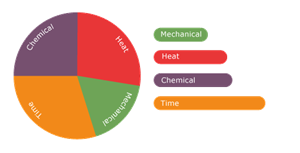 overall cleaning. Conversely a reduction in any given element must be compensated for by a corresponding increase in one or more of the other elements if cleaning is to be maintained. The relative contributions of each element varies considerably depending on which type of cleaning system is deployed.
- Mechanical action can be increased by using jetting nozzles, fan nozzles or wash down guns with higher pressures
- Heat can be modified by increasing the temperature of the cleaning fluid
- The chemical action component can be increased by the introduction of caustics and disinfectants
- Foams can be used to increase the time component of the mix by ensuring cleaning chemicals stay on the target for longer
In this section of our website we present a variety of products that can help improve various elements of the cleaning mix.
Sanitisation
Sanitising is not the same thing as cleaning. Sanitising is the process of the removal of bacterial pathogens to safe levels. What this generally means is that we want to achieve a 99.999% (log-5) reduction in target pathogens e.g. salmonella and e.coli. This can be validated by swab tests. For some high risk areas we might want a 99.9999% (log-6) kill rate.
Sanitising is not about achieving a total kill of all pathogens. That would be sterilisation. It is about getting to a generally agreed safe level to allow food to be processed and prepared.
In our blog article below, we look at four elements of sanitising: dwell time, coverage, surface preparation and dosing.
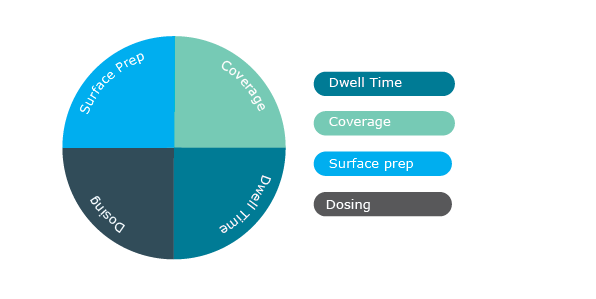
As with the cleaning model, if you increase one element, others can be reduced. As such, you can see how judicious equipment selection can play an role in influencing each of these elements.