Some 70 per cent of fires in commercial kitchens originate in faulty extract ventilation systems due to a build up of fat and grease¹. The costs of rebuilding damaged buildings or facilities can be exorbitant and it is estimated that 80 per cent of restaurants which suffer a serious fire incident never reopen or close within 18 months². Where insurance may have been expected to cover any damage if it is found that lack of proper cleaning and maintenance is at fault the policy may be invalidated.
Situation
Commercial kitchens use ventilation hoods to remove the polluted air and cool the heat produced by cooking equipment thus ensuring staff can work comfortably and in clear air. The hoods extract and filter hot air containing grease particles, grease vapours and odours which rise up from the professional cooking appliances below. These exhaust systems remove and thus prevent the build up of particles of fat, oil, grease and dust that can otherwise catch fire if a spark or hot ash should be sucked up into the ventilation system.
Problem
An international food services company which provided kitchen ventilation solutions had designed an innovative cooker hood for professional kitchens. The hood was equipped with spray nozzles, one type which served to cool the air, remove cooking grease from the exhausted air and prevent build up of grease or fat which could present a fire hazard and another type which provided an automatic wash cycle to remove greasy residues and reduce maintenance.
The client was using regular spray nozzles in the system but was finding that water consumption was extremely high. The company approached SNP to see if there was a way of optimising the system to carry out the grease containment and removal process while reducing the amount of water used. Quite apart from wishing to design a water efficient system it also wanted to assist its own clients in meeting their environmental targets.
The ideal scenario was a misting nozzle which could work with high pressure and optimise the capture and removal of grease particles and odours from the air.
Challenges
- Nozzles needed for grease extraction
- Needed to work with 2 to 3 bar pressure
- Solution needed to significantly reduce water consumption
Solution
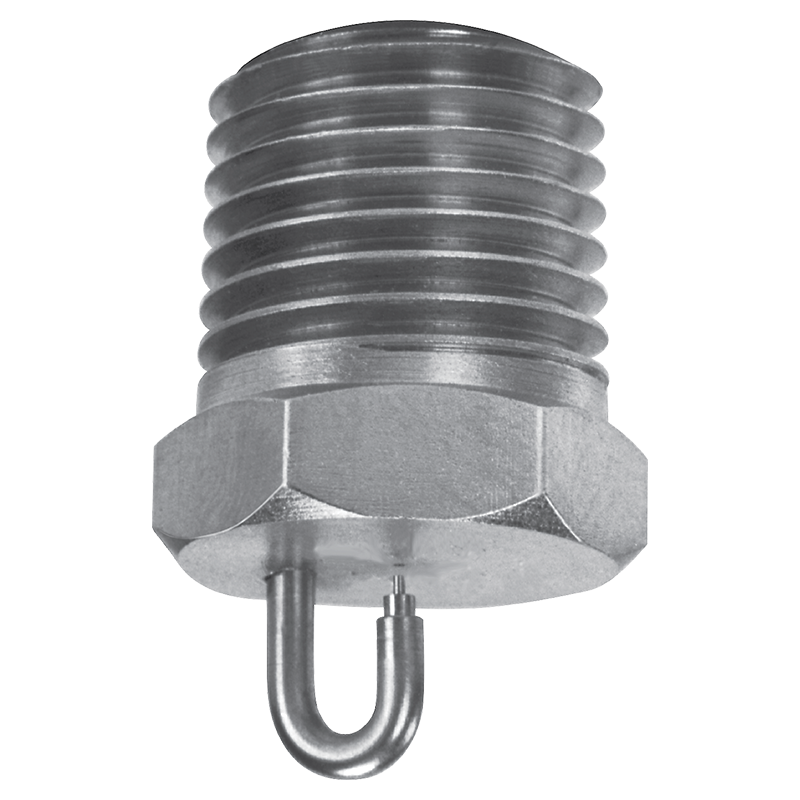
SNP engineers recommended the use of PJ misting nozzles in 316 stainless steel.
PJ nozzles are impingement nozzles which scatter liquid by impacting it on a pin immediately upon exiting the nozzle causing deflection onto the target area. They are extremely energy efficient.
These very small nozzles produce a cone shaped fog which is the finest fog of any direct pressure nozzle and captures particles of grease, fat and odours which are extracted by the exhaust system.
The nozzles were placed inside the exhaust plenum of the hood canopy. The client reported excellent results with the PJ15 nozzle working at between 2 to 3 bar and water consumption dramatically reduced.
Product
PJ Misting Nozzle
Benefits
- Finest fog of any direct pressure nozzle
- Spray pattern: cone-shaped fog
- Small size
- Uses less water
Learn more about the PJ nozzle.
Download the case study.

1 Kent Fire and Rescue Service
2 Cannon Fire