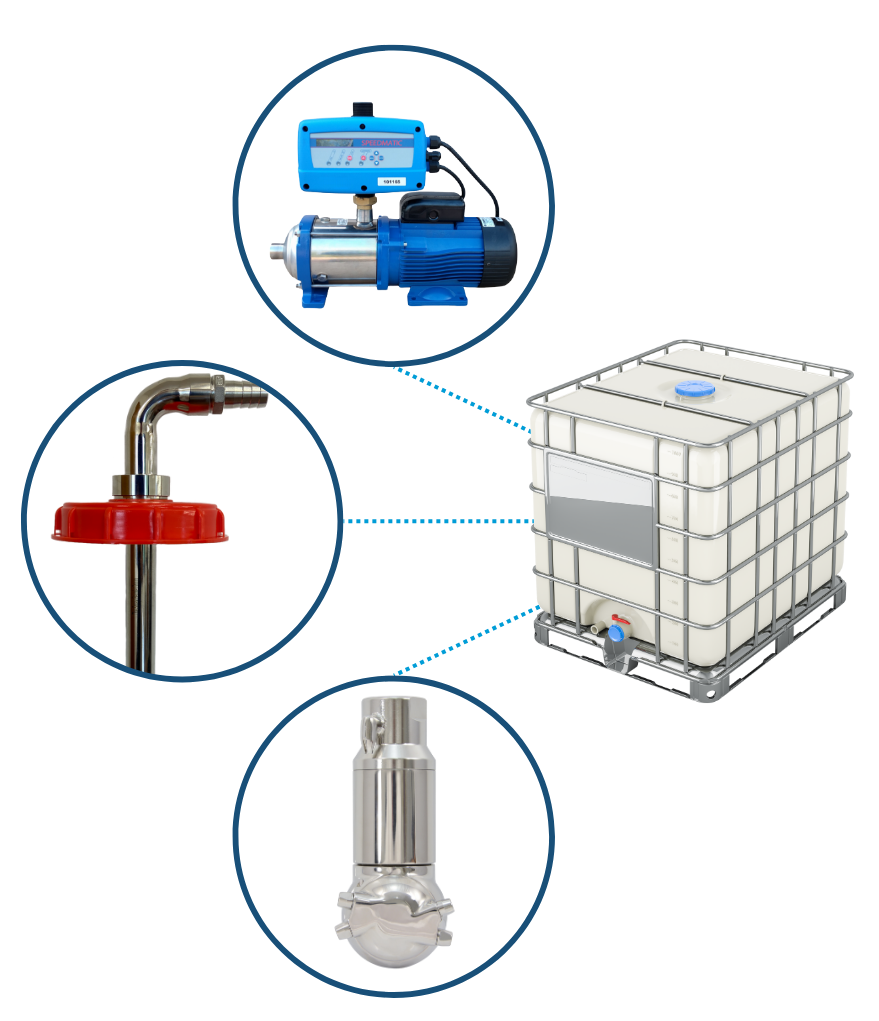
The time and water required to clean an IBC depend mainly on the type of residue inside it. Our IBC Cleaning Kit with Orbitor Eco rotary jet cleaning head delivers fast, thorough and water‑efficient cleaning for a wide range of residues.
Tough Residues
For heavy or stubborn residues, the rotary jet cleaner performs exceptionally well in around 10 minutes. Its high‑pressure spray pattern breaks down tough deposits quickly, giving much shorter cleaning times and better water efficiency than lower‑impact methods.
Medium Residues
For moderately tough residues, the Orbitor typically completes the same job in around 5 minutes, cutting both time and water usage in half.
Light Residues
Light, easily soluble residues clean much more quickly. Traditional systems might take around 5 minutes and use about 290 litres of water. A rotary jet cleaner can usually do this in around 2.5 minutes using about 145 litres.
Rotary jet cleaners do require a minimum operating time to complete a full cleaning pattern. They usually need at least 2 minutes to ensure every surface inside the IBC is reached, which equates to a minimum water usage of around 116 litres based on typical flow rates.
Where Spinners (rotary spray balls) Still Have a Place
Although our system uses rotary jet technology, spinner cleaners can still be more water‑efficient in very specific situations. Because they provide instant full coverage rather than following a timed rotation, they can clean extremely light residues in under 2 minutes. In those cases, they may use less water. However, for anything beyond the lightest residues, the rotary jet cleaner remains significantly more effective and efficient.