Mar 27, 2026, 09:34 AM
by
Catherine Lees

Selecting the right hygiene and application equipment has a direct impact on whether a business can meet regulatory expectations and maintain consistent standards. Many organisations focus on chemicals training or documentation but overlook the fact that their equipment can either support compliance or quietly undermine it. When the tools used for cleaning and sanitising work with operators rather than against them, they help maintain safer environments and more reliable outcomes.
A well‑chosen system does more than improve hygiene results. It also affects how regulators view your processes, how staff interact with cleaning tasks and how clearly you can demonstrate that you are applying chemicals safely and consistently. Equipment choice is therefore not just an operational decision. It is a compliance decision.
The Power of Being Seen to Be Doing the Right Thing
Regulators assess both evidence and behaviour. They want to see not only that surfaces are safe but that your approach looks controlled and credible. There is a psychological element to this. High quality foamers, foggers, mixing stations and spray systems provide visible reassurance that cleaning is organised, deliberate and measurable. Thick clinging foam shows where chemicals have been applied. Uniform spray patterns give confidence that surfaces have been covered. Consistent outputs also make it easier to prove that cleaning has taken place and has reached all required areas.
When a business uses equipment that looks robust, professional and fit for purpose it supports the perception of good hygiene practice. This does not replace real cleaning performance, but it completes the picture. Both staff and auditors need to see that the process is reliable, and the right tools help strengthen that trust.
Supporting Operator Compliance Through Ease of Use
Even the best chemical or the most detailed hygiene procedure will fail if operators find the equipment difficult to use. Compliance relies heavily on human behaviour and the simpler the tool the more consistent the outcome. Equipment that is intuitive, light to handle or pre‑set to the correct dilution removes opportunities for error.
Simplifying operation encourages better habits. Tasks feel less burdensome which makes staff more likely to complete them properly and at the right frequency. When operators trust the equipment and find it comfortable to work with there is less temptation to cut corners and more chance that your processes will be followed as intended.
Ensuring Even Distribution of Liquids
Regulatory standards expect surfaces to be fully cleaned and disinfected which means consistent and repeatable coverage. Poor distribution can leave untreated patches which lead to contamination risks and potential non‑compliance. Equipment that produces predictable spray or foam patterns helps ensure that all areas receive the correct amount of product.
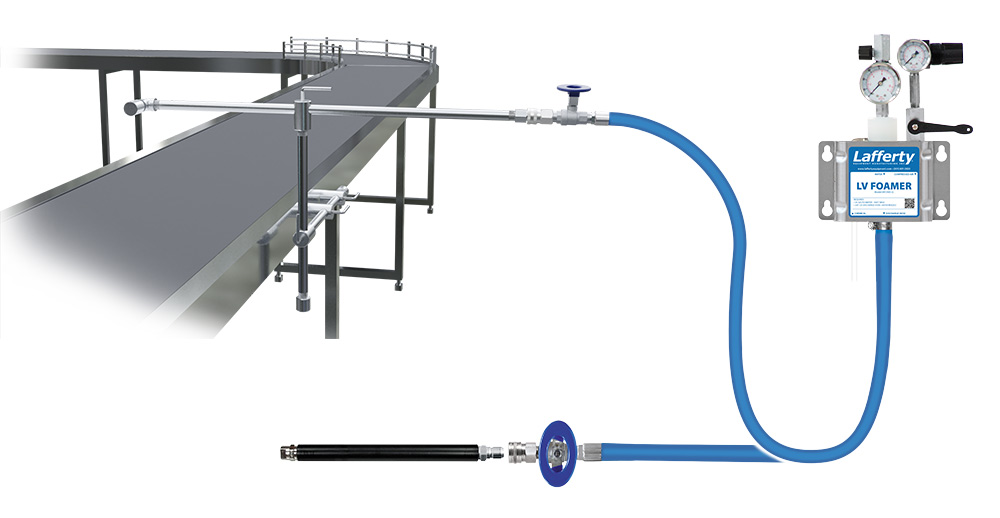
This is especially important in washdown environments where surfaces vary in shape size and accessibility. Systems that can project cleaning agents into corners across conveyors or onto vertical surfaces help reduce the likelihood of missed spots and make overall hygiene more dependable.
Accurate and Repeatable Mixing
Incorrect dilution is one of the most common causes of hygiene failure. Too weak and the product is ineffective. Too strong and it becomes unsafe for staff and potentially harmful to surfaces and equipment. Choosing application equipment with built‑in proportioning or Venturi‑based dilution removes the burden from operators and helps guarantee that every clean uses the right concentration.

Accurate mixing also helps with record keeping because you can demonstrate that the chemical was consistently applied at the approved strength. This supports both compliance and cost control since over‑dosing wastes product and under‑dosing puts food safety or hygiene integrity at risk.
Improving Operator Safety
Safe working conditions are a core regulatory requirement. Equipment that reduces operator exposure to concentrated chemicals supports both compliance and well-being. Systems that draw chemical directly from sealed containers prevent unnecessary handling while long‑reach spray or foam devices help staff maintain distance from difficult or hazardous areas.
Other safety benefits include reduced manual effort predictable triggers or controls and minimising the need for operators to climb reach or lift. When equipment is chosen with safety in mind businesses lower risk, improve training outcomes and provide a more controlled working environment.

Conclusions
Investing in high quality chemical mixing and distribution equipment is money well spent. It is almost always the case that the ongoing cost of the chemicals and water used through such systems dwarfs the cost of the equipment itself. As such, cheaper but inferior equipment will almost certainly cost more in the long run by wasting chemical or providing inadequate sanitation.