Apr 1, 2026, 12:06 PM
by
Catherine Lees
The selection of an appropriate chemical mixing system is among the most consequential decisions a facility manager or process engineer can make. Whether chemicals are being blended for food processing, agricultural application, water treatment, industrial cleaning or manufacturing, the method of mixing directly affects the safety of operators, the consistency of the end product, the operational costs of the facility and the long-term reliability of the process.
Three main systems
Three systems dominate industrial and commercial chemical mixing: Venturi-based injection, manual mixing by human operators and automated chemical dosing pump systems. Each carries a distinct profile of advantages and limitations that must be carefully weighed against the specific demands of the application at hand.
This article evaluates all three approaches across five critical dimensions: operator safety, dosing accuracy, initial capital cost, ongoing maintenance requirements and calibration demands. Understanding these trade-offs equips decision-makers to select the system most appropriate for their context, rather than defaulting to whichever technology is most familiar or immediately available.
Venturi Chemical Mixing Systems

A Venturi system operates on a deceptively simple physical principle: when a fluid passes through a constricted section of pipe, its velocity increases and its pressure drops. This pressure differential draws a secondary fluid, the chemical concentrate, into the primary flow stream through an injection port. The result is passive, continuous mixing with no moving parts in the mixing element itself. Venturi injectors are widely used in irrigation fertigation, pool chemical dosing, and industrial process lines.
Operator Safety
From an operator safety standpoint, Venturi systems offer meaningful inherent advantages. Because the mixing process is continuous and contained within a closed loop, operators have limited need to handle concentrated chemicals directly during routine operation. The risk of splashing or accidental exposure is substantially lower than in manual mixing environments. However, Venturi systems are not without hazard: initial setup, priming, and line maintenance still require operator interaction with chemical lines. Back-siphoning — the inadvertent reverse flow of chemicals into the water supply — poses a contamination and safety risk if check valves are absent or fail. Properly engineered systems include anti-siphon devices and chemical-resistant materials throughout, but poorly specified installations can create serious hazards. On balance, a well-designed Venturi system keeps operators at greater distance from concentrated chemicals during normal operation than the alternatives.
Accuracy
The accuracy of Venturi injection is its most significant weakness. Injection ratios are governed by the pressure differential across the Venturi throat, which in turn depends on the flow rate and pressure of the carrier fluid. If either variable fluctuates due to changes in line pressure, partial blockages, or variations in source supply the injection ratio shifts accordingly. Most Venturi injectors are designed to operate within a specific flow range, and outside that range their metering becomes unreliable. In applications where precise chemical concentrations are critical, such as pH adjustment or disinfection dosing, this sensitivity to hydraulic variation can be a serious limitation. For less precision-critical applications, such as general fertiliser delivery in drip irrigation, the inherent imprecision of Venturi injection is often acceptable, especially when supported by downstream monitoring.
Initial Cost
Venturi injectors are among the least expensive mixing technologies available at the component level. A quality stainless steel or engineering polymer injector suitable for light industrial use can be acquired for a modest outlay, and installation costs are relatively low given the absence of electrical components in the core mechanism. For small-scale or budget-constrained operations, this represents a compelling entry point. The total installed cost rises meaningfully, however, when proper safety components (check valves, pressure gauges, isolation valves, chemical-resistant tubing, and secondary containment) are included as they should be.
Maintenance and Calibration
Maintenance requirements for Venturi systems are generally low, which is one of their most celebrated attributes. With no moving parts in the injector itself, there are no impellers, seals, or diaphragms to wear out under normal operating conditions. The primary maintenance concerns are fouling of the Venturi throat, particularly when handling viscous or precipitate-forming chemicals, and degradation of seals and fittings due to chemical attack. Regular inspection of the injection port and chemical supply lines, combined with periodic flushing, is typically sufficient for reliable operation.
Calibration of a Venturi system is accomplished by adjusting the pressure differential across the injector, often through a bypass valve arrangement, or by selecting injectors of different orifice sizes to achieve a target injection ratio. This process is relatively straightforward but inherently approximate. Once set, the injection ratio will drift if process conditions change, meaning that Venturi systems require periodic re-verification against the actual chemical concentration being delivered. They do not self-correct, and they do not offer digital feedback or logging, a limitation in regulated or audited environments.
Manual Mixing Systems
Manual mixing represents the oldest and simplest form of chemical blending: an operator measures out chemical concentrates and diluents by hand and combines them in a mixing vessel, typically using volumetric measures, weight scales, or titration guides provided by the chemical supplier. Despite its apparent simplicity, manual mixing remains in widespread use across small operations, field applications, and situations where automation is impractical.
Operator Safety
Manual mixing poses the highest operator safety risk of any method discussed here. Every manual mix requires the operator to directly handle concentrated chemicals, measure them in open containers, and transfer them to mixing vessels, all activities that carry inherent risk of skin contact, inhalation of vapours, and splash exposure. The severity of these risks scales with the hazard level of the chemicals involved; for caustic acids, strong alkalis, or toxic biocides, manual mixing without rigorous personal protective equipment (PPE) protocols and engineering controls represents an unacceptable occupational health risk.
Human error compounds the safety risk further. Operators working under time pressure, fatigue, or inattention may skip PPE steps, mis-measure concentrates, confuse similar-looking chemicals, or fail to follow dilution sequences correctly, all of which can lead to acute chemical exposure or runaway exothermic reactions. Regulatory frameworks in most jurisdictions, including COSHH regulations in the United Kingdom and OSHA's Hazard Communication Standard in the United States, impose stringent requirements on manual chemical handling that add administrative overhead and training costs. In summary, manual mixing is the most dangerous of the three methods from an occupational safety perspective and this fact alone disqualifies it from serious consideration in most modern industrial environments when automated alternatives exist.
Accuracy
The accuracy of manual mixing is entirely dependent on the skill, attention, and training of the operator performing the task. Under ideal conditions e.g a calm environment, well-calibrated measuring equipment, a clear and detailed procedure, and a careful operator, manual mixing can achieve reasonable accuracy. In practice, variability between individual operators, between batches, and over time is substantially higher than with either of the automated alternatives. Volumetric measurements introduce parallax errors; graduated cylinders and buckets are rarely calibrated to laboratory standards; temperature effects on liquid density are seldom accounted for; and operator assumptions about what constitutes a 'full' measure vary from person to person. For applications where concentration must be tightly controlled (effective biocidal products, for example, where being below minimum inhibitory concentration renders the product ineffective and above a threshold concentration creates hazard) manual mixing is fundamentally unsuited.
Initial Cost
The initial capital cost of manual mixing is effectively zero in equipment terms. Mixing vessels, measuring jugs, and stirring implements are low-cost commodity items available from any industrial supplier. This apparent advantage, however, must be balanced against the true cost of manual mixing when labour time, PPE provision, training, regulatory compliance, incident response and waste disposal are included. In high-frequency applications where chemical solutions must be prepared multiple times per day the cumulative labour cost of manual mixing can dwarf the capital cost of an automated alternative within a relatively short payback period.
Maintenance and Calibration
Manual mixing requires no mechanical maintenance, as there is no equipment to service. Calibration, in the traditional sense, is replaced by periodic verification of measuring instruments e.g. scales, pipettes, and graduated vessels and by training refreshers to ensure operators are following procedures correctly. Documentation of each mix batch, required in many regulated environments, adds administrative burden but also creates an audit trail that other methods must replicate electronically. The lack of mechanical maintenance is genuinely advantageous in remote locations or resource-constrained environments where technical support is unavailable, which partly explains why manual mixing persists in agricultural field applications and developing-world contexts despite its drawbacks.
Dosing Pump Systems
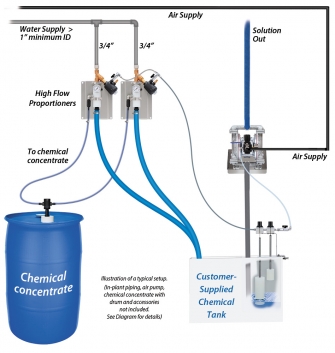
Dosing pump systems use precisely controlled positive-displacement pumps, most commonly peristaltic, diaphragm, or piston types to inject a measured volume of chemical concentrate into a process stream at a defined rate. Modern dosing systems range from simple fixed-rate mechanical pumps to sophisticated electronically controlled units that respond to real-time process feedback from sensors measuring pH, conductivity, turbidity, or other parameters. They are the workhorse of water treatment, pharmaceutical manufacturing, food processing and industrial chemical handling worldwide.
Operator Safety
Dosing pump systems offer operator safety characteristics broadly comparable to well-designed Venturi systems, with some significant additional advantages. Once a dosing system is correctly installed and commissioned, routine operation requires minimal operator intervention: chemicals are stored in sealed bulk containers and transferred through closed pipework directly to the injection point, with no routine need for operators to handle concentrates. Electronic systems with automatic shut-off, leak detection, and high/low-level alarms add further layers of protection. Maintenance activities such as pump head replacement, tubing changes in peristaltic systems and diaphragm inspection do require some interaction with chemical lines, but this can be scheduled and performed under controlled conditions with appropriate PPE, rather than occurring as a continuous feature of daily operations as in manual mixing.
One safety risk specific to dosing pumps is the potential for over-dosing due to pump malfunction or control system error. A pump that runs continuously due to a failed float switch or faulty controller can deliver a toxic or corrosive concentration of chemical into the process stream with potentially serious consequences. Robust dosing systems therefore incorporate redundant interlocks, independent alarms, and dose verification mechanisms that add to system complexity but are essential for safety-critical applications.
Accuracy
Dosing pumps provide the highest level of accuracy and repeatability of the three systems. Positive-displacement pumps deliver a defined volume per stroke or revolution that is largely independent of process pressure variations within the pump's rated range. High-quality diaphragm and peristaltic pumps achieve dosing accuracies of plus or minus one to two percent of set point under stable conditions and closed-loop control systems that adjust pump output based on real-time process measurements can maintain target chemical concentrations to even tighter tolerances. This level of accuracy is essential in applications such as drinking water chlorination, pharmaceutical buffer preparation, and electroplating bath chemistry, where excursions outside tight concentration windows either compromise process quality or create regulatory non-compliance.
The accuracy of a dosing pump system is, however, contingent on the accuracy of the flow measurement or process feedback it relies upon. A pump correctly calibrated to deliver a precise volume per hour may still produce inaccurate end concentrations if the carrier flow rate varies unpredictably or if the flow meter drifts between calibration intervals. System-level accuracy therefore requires attention to the entire measurement and control chain, not merely the pump itself.
Initial Cost
Dosing pump systems carry the highest initial capital cost of the three methods reviewed here. A basic fixed-rate diaphragm pump for light-duty application is available at modest cost, but a complete installed system, including the pump, chemical storage, dosing lines, injection fittings, control panel, sensors, alarms, and secondary containment, represents a significant capital investment. Sophisticated closed-loop systems with digital control, data logging, and remote monitoring capabilities can involve substantial installed costs, placing them beyond the reach of smaller operations without a clear return-on-investment case.
Despite this higher upfront expenditure, the total cost of ownership for dosing pump systems is frequently lower than manual mixing over multi-year operational horizons. Reduced labour costs, lower chemical wastage from overdosing, fewer safety incidents, and greater process reliability all contribute to cost recovery that typically materialises within one to three years in medium-to-high volume applications.
Maintenance and Calibration
Dosing pumps have the highest maintenance requirements of the three systems, which is both their principal operational drawback and the price of their superior accuracy. Peristaltic pumps require periodic tubing replacement as the elastomeric tube fatigues under continuous compression; the replacement interval varies from weeks to months depending on the chemical being dosed, the tube material and the operating duty cycle. Diaphragm pumps require diaphragm inspection and replacement, valve servicing and lubrication of drive components. All dosing pumps benefit from regular cleaning of the injection point to prevent chemical build-up and blockage.
Calibration of dosing pump systems is a more formal and rigorous process than for the other two methods. Pumps must be calibrated by measuring actual output volume against a reference standard typically by collecting pump output in a graduated cylinder over a timed interval and adjusting the stroke rate, stroke length, or speed setting to achieve the target dose rate. This process must be repeated at regular intervals and after any pump head replacement, chemical change, or process condition change. Modern electronic dosing systems can partially automate this process through flow verification routines, but manual verification remains best practice in regulated applications. The calibration burden, while genuine, is offset by the certainty that when a dosing pump system is properly calibrated, it will deliver its set dose with high consistency until the next calibration event.
Comparative Summary and Recommendations
Viewed across the five dimensions of this analysis, the three systems occupy distinct and largely non-overlapping niches. Manual mixing occupies the lowest-cost, highest-risk position: it demands the least capital investment but creates the greatest ongoing operator exposure, the highest variability in output concentration, and the most significant regulatory compliance burden. It is most defensible only where volumes are very low, automation is genuinely impractical, and the chemicals involved carry limited hazard.
Venturi injection occupies a middle position that is particularly attractive for cost-sensitive applications where the process is tolerant of moderate concentration variability. Its safety profile is strong during steady-state operation, its maintenance demands are minimal, and its capital cost is low. It is well-suited to irrigation fertigation, pool dosing, and general industrial rinsing where flow conditions are stable and tight concentration control is not required. Its fundamental limitation,sensitivity to hydraulic variation, constrains its utility wherever pressure or flow rates fluctuate materially.
Dosing pump systems offer the highest accuracy, the most robust safety architecture, and the greatest capability for integration with automated process control. They are the appropriate choice wherever chemical concentration must be tightly controlled, wherever regulatory requirements mandate verifiable dosing records, or wherever the volume of operation justifies the capital investment. Their higher maintenance demands and upfront costs are genuine considerations, but for medium-to-large scale or safety-critical applications they represent the most complete and defensible solution.
Ultimately, the optimal choice depends on the hazard classification of the chemicals involved, the required dosing accuracy, the volume and frequency of operation, the regulatory environment, and the availability of technically capable maintenance personnel. In many facilities, a combination of approaches is appropriate: dosing pumps for critical process chemicals, Venturi injection for secondary treatments, and manual mixing reserved only for one-off or emergency situations with strict procedural controls in place.
Conclusion
Chemical mixing is a foundational process in countless industries, and the method chosen to accomplish it shapes the safety, efficiency, and reliability of everything downstream. Venturi systems reward the engineer who values simplicity and low maintenance over precision. Manual mixing persists where pragmatism demands it but should be regarded as a technology of last resort in any environment where hazardous chemicals are involved.
Dosing pump systems, for all their complexity and cost, represent the state of the art in controlled chemical delivery and in applications where accuracy, safety, and auditability matter, they set the standard against which the other methods must be measured.
Facilities that take a systematic approach to evaluating these trade-offs will find that the short-term savings of simpler systems are frequently outweighed by the long-term costs of inaccuracy, incidents and non-compliance that arise when the wrong tool is chosen for the job.