The Critical Role of Storm Tank and Screen Cleaning Systems in AMP8’s £11 Billion Spill Mitigation Plan
The United Kingdom’s water industry is poised for its most ambitious transformation yet under the AMP8 (Asset Management Period 8) investment cycle, which runs from 2025 to 2030. Backed by an unprecedented £108 billion investment — the largest in the sector’s history — AMP8 is focused not only on maintaining and upgrading aging infrastructure, but also on addressing growing environmental and regulatory challenges. A significant £11 billion of this total has been earmarked specifically for stormwater and sewage spill mitigation, reflecting mounting pressure from regulators, the public, and environmental groups to curb pollution in rivers, lakes, and coastal waters.
At the heart of this environmental push lies the urgent need for more storm water retention tanks and combined sewage overflow (CSO) systems. It is estimated that some 2000 such systems will need to be updated, refurbished or built in the AMP round of funding. This storm water management infrastructure is vital if the target of reducing spills and sewage discharges into water ways by 44% is to be met.
Much of this new infrastructure will require specialised cleaning systems.
Storm tank cleaning
Storm tanks are designed to provide temporary storage of excess wastewater during peak flows. However, without effective and regular cleaning, these tanks become a source of secondary pollution. If not cleaning properly the residue that remain will decompose and start to smell. The pollution from discharge into water ways may be solved but the storm tank but the smell from the tank now results in odour pollution.
In addition to this, inadequate or infrequent cleaning can result in a premature degradation of the tank reducing the life span of this vital infrastructure.
AMP8’s targeted spill mitigation funding recognizes this issue. Utility companies are being incentivised and, in many cases, mandated to install automated storm tank cleaning systems that prevent the build-up of odour causing debris, reduce maintenance requirements and extend asset life.
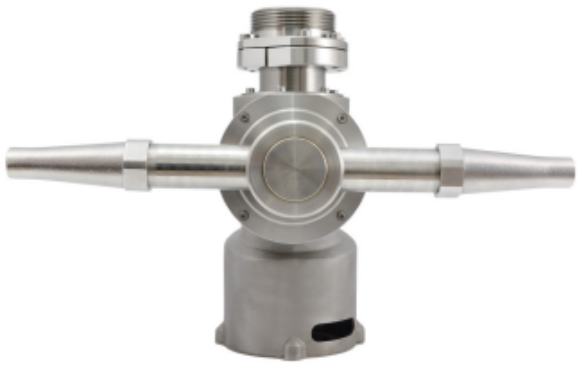
There are a variety of different types of storm tank cleaning system available. The most versatile and effective systems use rotary jet cleaning heads, such as our Storm Blaster, to methodically clean the tank. Whilst there are some exceptions, most storm tanks can be cleaned using the Storm Blaster system. One of the main advantages is that no modifications to basic tank designs need to be made. Some cleaning systems require that special channels, slopes or catchment sumps need to be specified into the tank build. With a properly specified rotary jet cleaning system no such special features need to be incorporated into the tank build. If there is a sufficient drain gradient of 1% or more (which there always is!) then pretty much any tank design can be cleaned effectively.
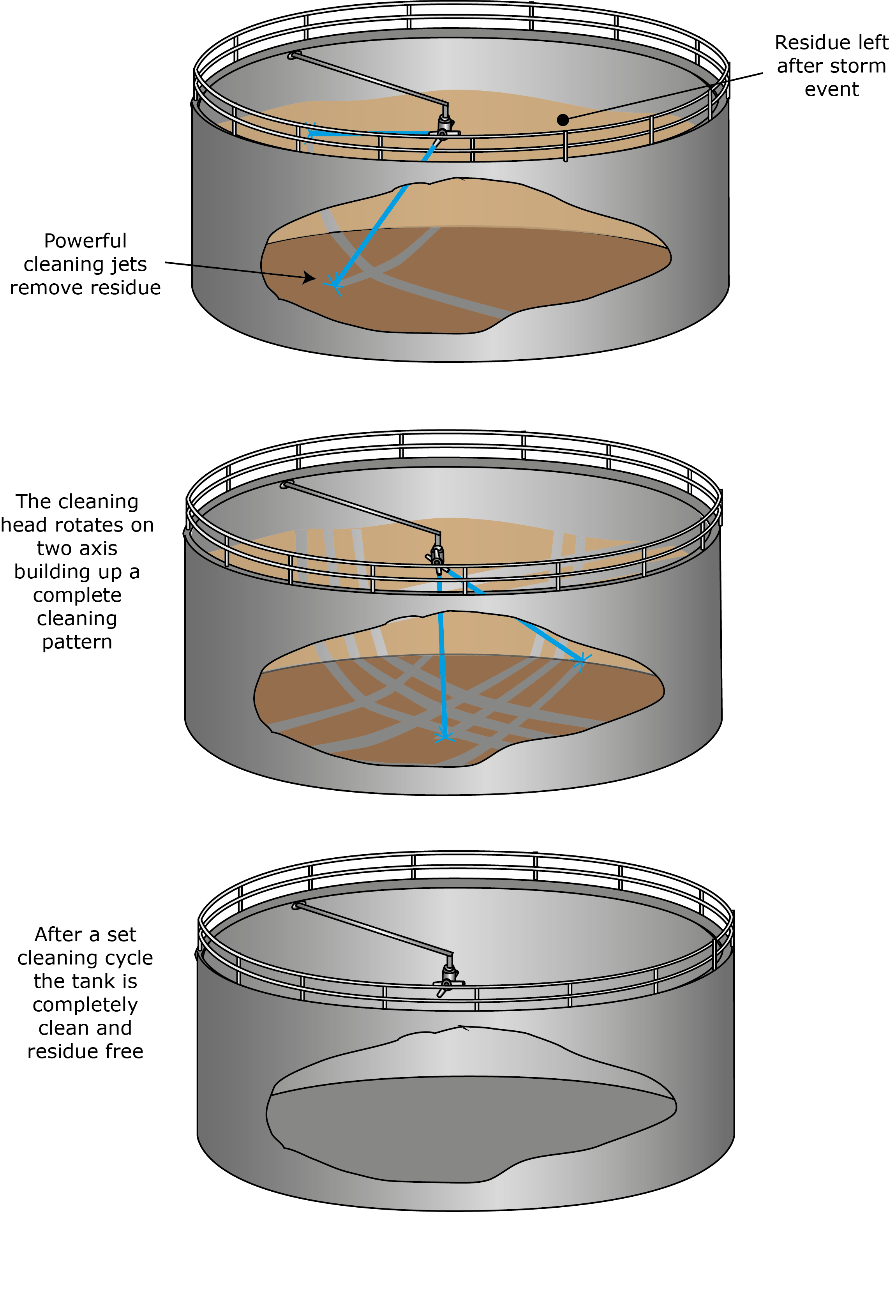
As no tank modification or special design features are needed, this brings down the overall cost of the build. In addition, rotary jet cleaners are often cheaper to install than the alternatives, they have a lower operating and maintenance cost, and they give a better overall clean. In pretty much every other industry that has very large tanks rotary jet cleaning systems are the default method of cleaning. Of note is the cleaning of large ocean-going oil tankers. This industry has huge tanks that are often far bigger than storm water tanks. The industry standard for cleaning such tanks is rotary jet cleaning heads. Indeed, our Storm Blaster rotary jet cleaner is based on exactly that technology. Almost all industries have now independently converged on rotary jet cleaners as the most effective was to clean large tanks, and the water industry is no exception.
Screening cleaning
Screening systems are an equally vital part of the AMP8 upgrades, acting as the last line of defence before wastewater is discharged into the environment. CSO screens will remove solids from overflowing sewage systems during storm events. This allows the solid free excess water to be discharged or stored in storm tanks. Without such screening solids and rags will end up in the seas and water way.
The problem is that screens tend to block up with solids over time and so need to be regularly cleaned. An inadequately cleaned screen will not allow water to pass through it at the required rate and so the overflow system will not work. This will mean that the excess water, containing all the solids, will escape at some other point. This will then result in an uncontrolled discharge.
Just as with storm tanks, attention needs to be given to cleaning systems to ensure CSO screens remain fully functional. The trend is towards automated rather than manual cleaning as it is cheaper and more effective in the long run.
Screen cleaning systems
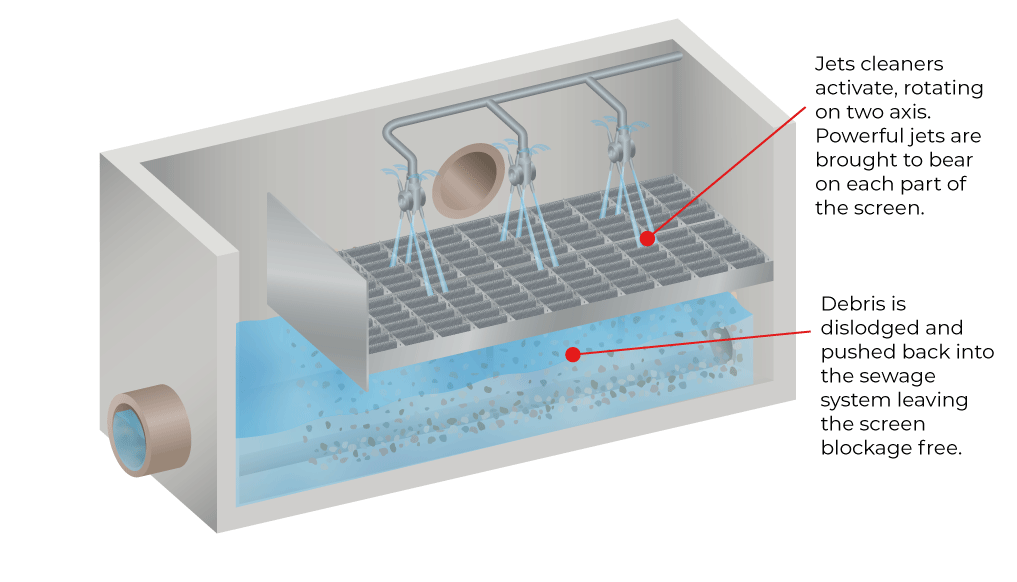
Typically, CSO screens are on a much smaller scale than the actual storm tanks. They also have specific features that means a different type of cleaning head are required. Many static screens have a wave form which makes them difficult to clean from a fixed point because the wave nature of the screen blocks any cleaning jets. As such we need to ensure that the angle at which the cleaning jet hits the screen is large enough to overcome the wave form of the screen.
This requires a different type of tank cleaning head, one that is more narrowly confined in its cleaning pattern. Due to the restricted cleaning pattern it is necessary have more nozzles on these types of cleaner. Our Screen Blaster machine is perfect for this task, It has 8 nozzles and can be restricted to a 90 degree downward clean pattern making ideal for cleaning static wave form COS screens.
As with the Storm Blaster system our Screen Blaster CSO screen cleaners are highly efficient, will work with almost all standard screen designs and can be fully automated. Effective automated cleaning will ensure that CSO screens remain debris free and so will maintain their required flow through rate. A small upfront investment in an automated or semi-automated cleaning systems reduces the need for manual cleaning and so saves money on the long run as well as helping to ensure the system works properly.
A Broader Context
The £11 billion investment in stormwater and spill reduction is not just about infrastructure — it’s about public trust and ecological responsibility. In recent years, public concern over raw sewage discharges has reached record highs, prompting government and regulatory action. Advanced storm tank and screen cleaning systems offer a measurable, cost-effective way for utilities to help ensure they meet those obligations.
Conclusion
The huge investment in the UK’s water infrastructure needs to be done in a cost-effective way. It is our belief that tank and screen cleaning systems are one way to help ensure UK taxpayers gets the most out of this investment. The investment in proper automated cleaning systems represent only a very tiny fraction of the £11 billion being invested in spill reduction but the impact they can have on the effectiveness and efficiency of the whole system can be disproportionally high. Its one of the often neglected little things that can make a huge difference. Good cleaning systems save money, time, effort and potentially fines from the EPA in the long run.
Download the PDF version.