.png?sfvrsn=d25fc892_1)
There are four basic spray patterns for any given nozzle: full cone, hollow cone, flat fan and solid stream. The misting, spiral full cone and the square spray patterns are all derivatives of these four basic patterns.
BASIC SPRAY PATTERNS
FULL CONE
A full cone nozzle generates a circle of spray if you're looking face on at the nozzle, and this is a filled in circle of spray. The fluid distribution is even across that circle.
This spray pattern has the lowest impact of all the spray patterns.
You can have a spray angle which is defined as the angle of that cone, between 30 and 170 degrees. Drop sizes are typically medium for any given pressure.
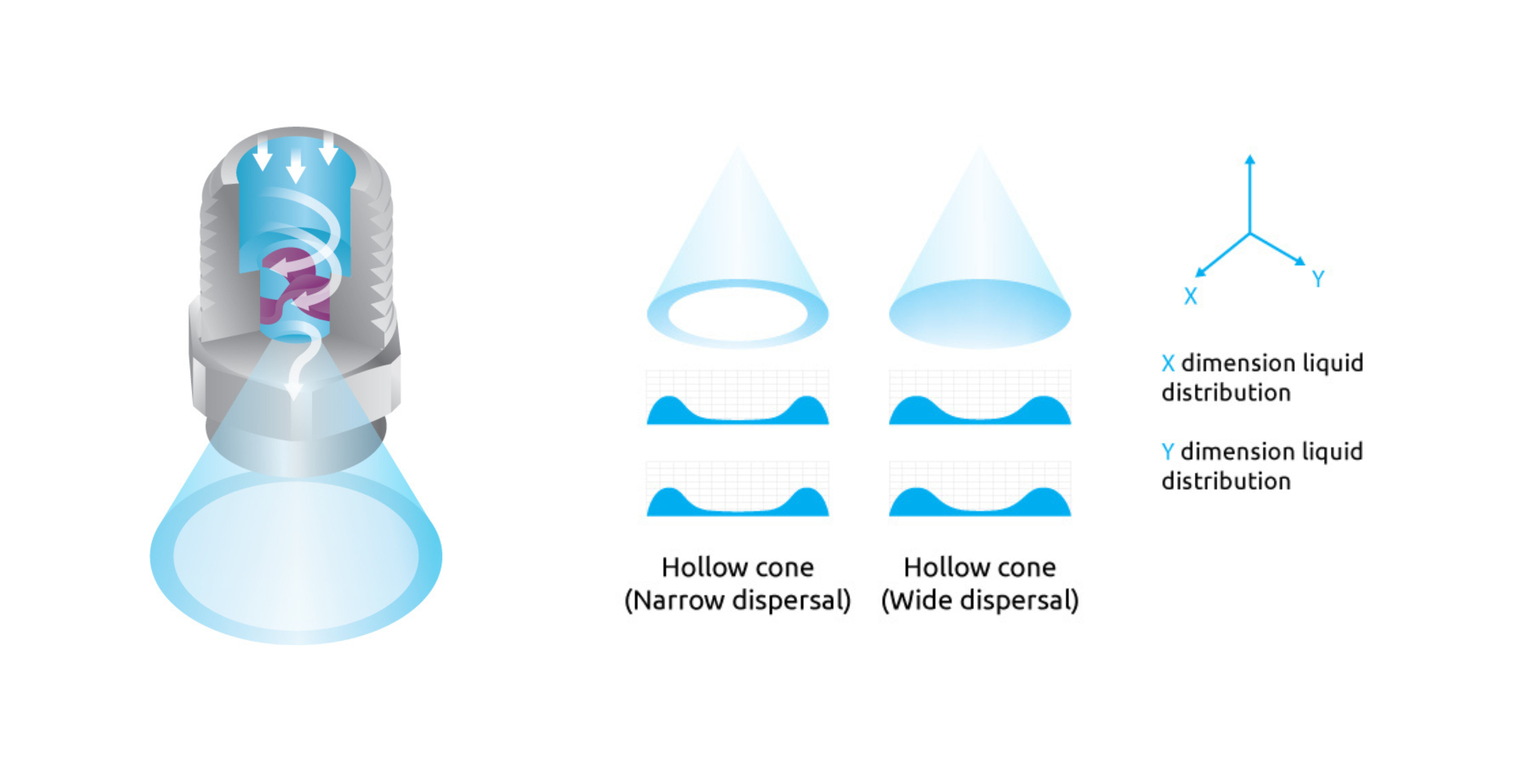
HOLLOW CONE
A hollow cone nozzle is defined as giving a circle of spray rather than a filled in circle of spray; all the fluid is pushed towards the edge to form a band of spray. Again, this is a low impact spray pattern. It also has the smallest
droplet size of all four basic spray patterns.
FLAT FAN
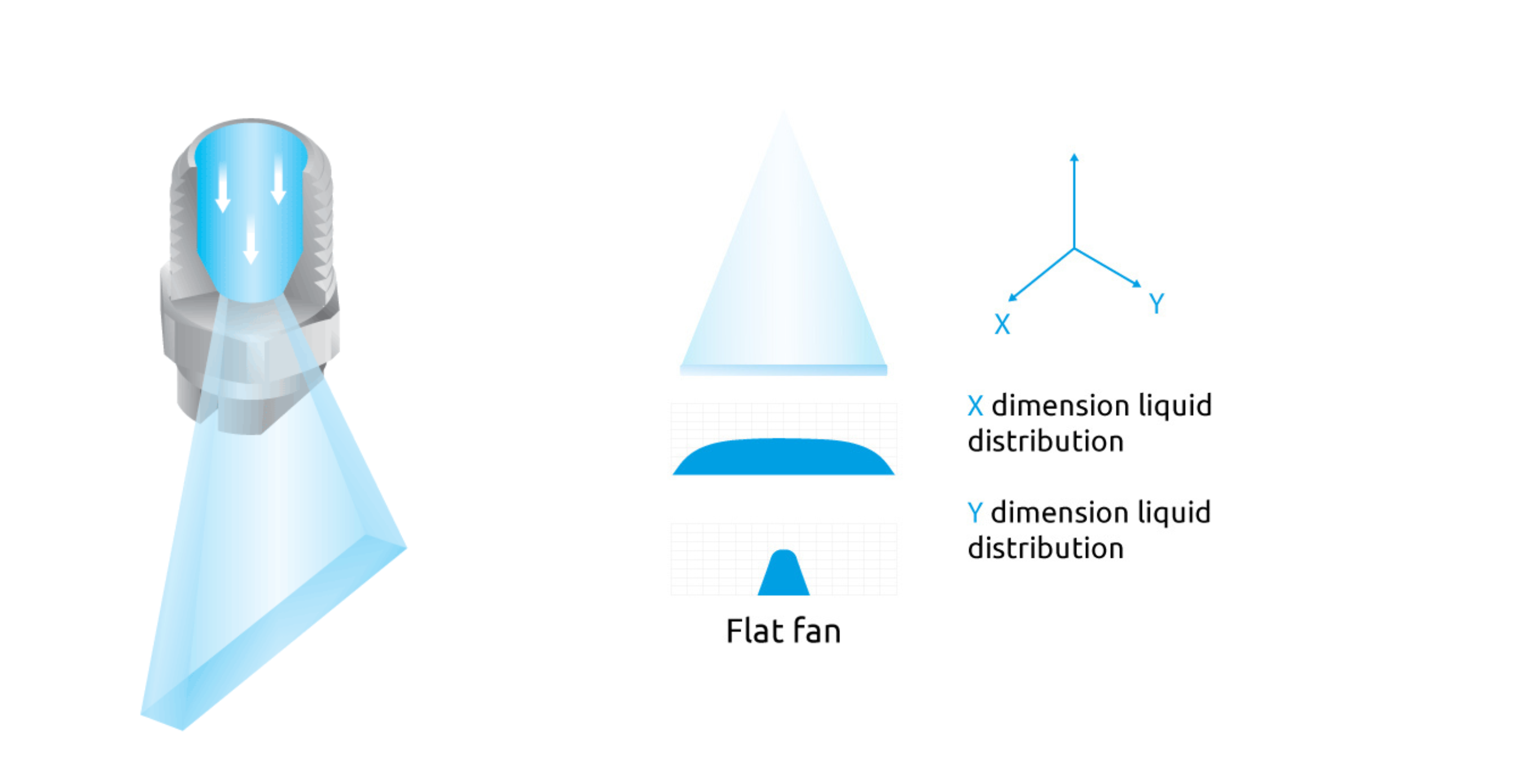
A flat fan nozzle produces a line of spray rather than a circle. And because the fluid is being concentrated into a smaller area, this spray pattern offers higher impact.
Similar to the cone nozzles, flat fans can have a spray angle between 10 and 145 degrees approximately. Typically with these types of spray nozzle, the drop size is larger.
SOLID STREAM
Essentially, this is a 0 degree flat fan nozzle. It has a much higher impact because again, all the fluid is being concentrated into a point.
There isn’t a drop size with this nozzle type.
It is not designed to atomise the fluid, but rather to keep it in a coherent laminar flow.
.png?sfvrsn=1454c892_1)
BONUS SPRAY PATTERNS
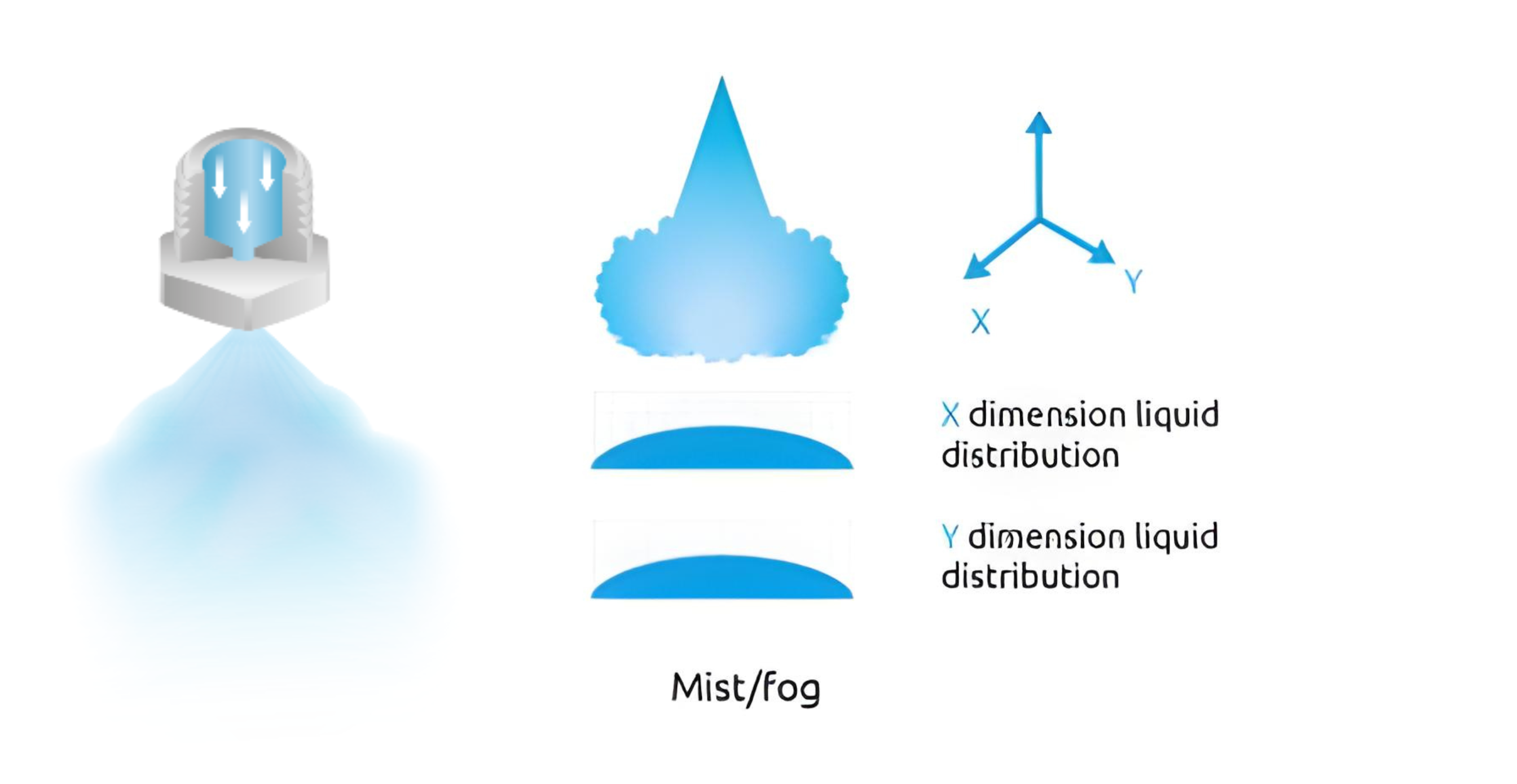
MISTING
This is not a true spray pattern; misting patterns will either be a hollow cone or a full cone nozzle, typically running at higher pressures.
The hollow or full cone pattern is visible very close to the nozzle, but because of the increased atomisation, it turns into a mist quite close to the nozzle.
The outcome is an amorphous mist which doesn’t have a proper pattern. It is wafted around by the air.
SPIRAL
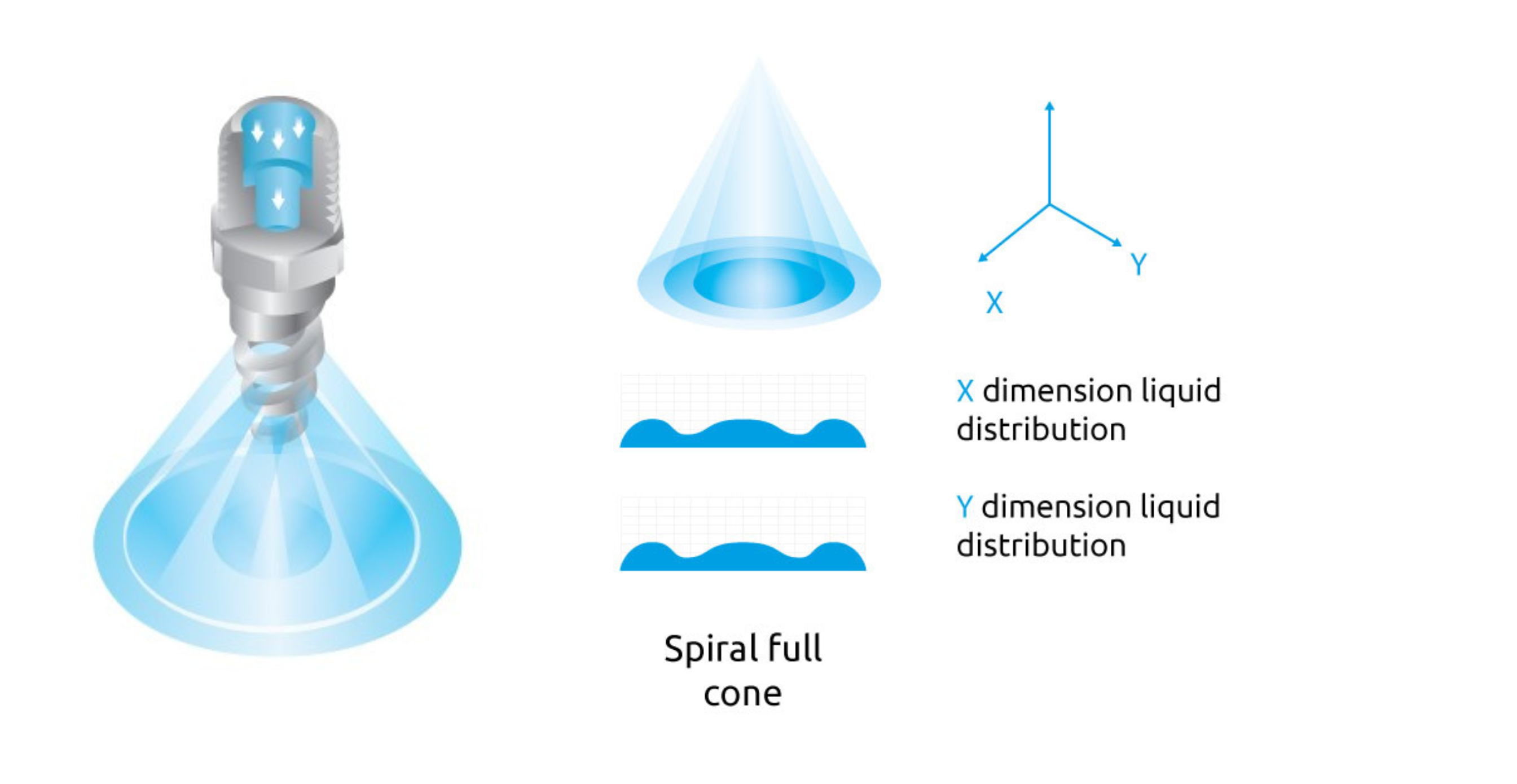
These can either produce a full cone or a hollow cone, but the pattern is slightly different; it’s derived from concentric hollow cone patterns that are formed by the spiral shape of the nozzle and the nozzle can be designed to have these concentric hollow cone patterns overlapping to form an approximate full cone pattern. But there will be considerable variation at different parts of that full cone. They can also be designed so that all the hollow cone patterns converge into one big hollow cone pattern. That could have some implications for fluid distribution.
SQUARE
Square pattern nozzles are pairs, and they spray into each other and interact to form a square pattern. This can be useful when trying to fit the spray into a rectangular or square shape.
.png?sfvrsn=5c54c892_1)