.png?sfvrsn=104dc892_1)
It is not just the food processing industry that needs its process vessels to have exemplary levels of cleanliness. Where a tank is used to produce different versions of the same product, cross contamination by colour or scent can cause entire batches to be ruined.
Situation
One of the UK’s leading household products manufacturers asked SNP to help find a solution for cleaning eighteen detergent manufacturing tanks. The company required a very high level of cleaning between batches because it was producing products in different colours and could not allow any dye residue to contaminate subsequent batches.
The existing clean in place system was not providing a sufficient level of cleanliness and was using excessive volumes of cleaning liquid. The cleaning regime consisted of a mixture of water, caustics and acids.
Problem
The client was using a rotary spray ball cleaning-in-place (CIP) system. These spray balls wore out and became blocked easily which resulted in ineffective cleaning. As a consequence additional cleaning cycles were required resulting in excessive liquid consumption.
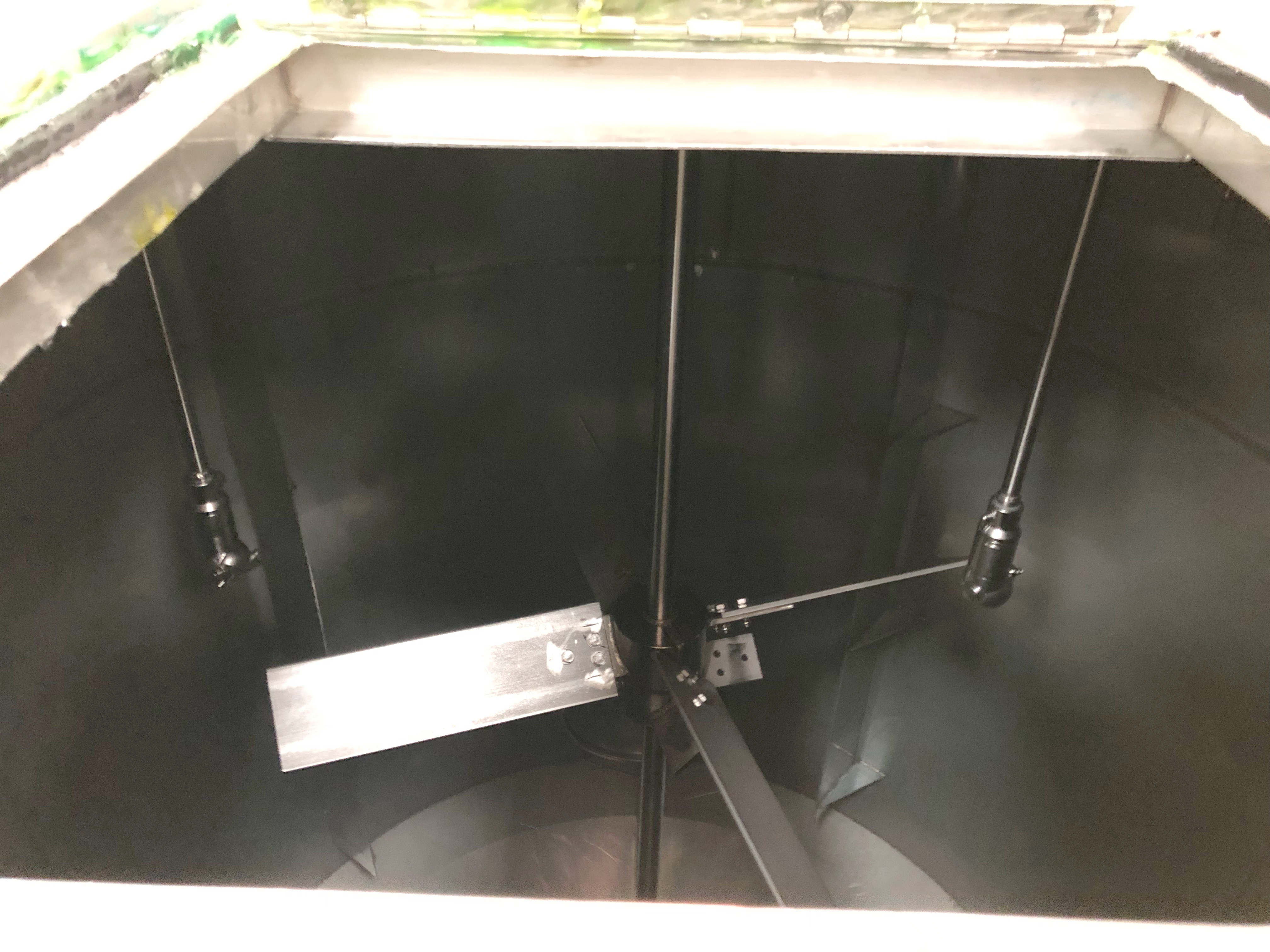
Although the tanks were relatively small and the detergents did not leave heavy or sticky residues, each tank contained a central agitator with stirring paddles. This created shadowing where the internal equipment prevented full coverage by the cleaning system.
Each tank measured 2.5 m in diameter and 3 m in height. The central paddle was 40 mm in diameter. The client was looking for a solution that would ensure every internal surface of the tanks was thoroughly cleaned while reducing liquid usage and providing a fast cleaning cycle to minimise downtime between production batches.
Solution
SNP proposed the use of Orbitor Eco rotary jet cleaning heads. Due to the presence of the agitator running through the centre of each tank, two Orbitor Eco units were required to eliminate shadowing.
Two 4 × 5 mm Orbitor Eco cleaners were installed in each tank. These were positioned on either side of the tank, 6.25 cm in from the tank walls and 6.25 cm from the agitator. This configuration ensured complete coverage of all internal surfaces.
The Orbitor Eco model was selected due to its fast cycle time and suitability for the light to moderate residues produced during detergent manufacture.
Challenges addressed
- Shadowing caused by the central agitator and paddles
- Requirement to reduce cleaning cycle time
- Requirement to reduce water and chemical consumption
- Need for a low maintenance and robust cleaning system
Learn more about spray balls v rotary jet cleaning heads in our video.