Mar 27, 2026, 11:48 AM
by
Catherine Lees

Every day, in food factories around the world, production lines shut down and the washdown begins. But not all cleaning is the same. There's a crucial difference between simply cleaning a surface, sanitising it, disinfecting it and sterilising it and
these aren't just different words for the same thing. They represent four distinct levels of microbial control, each more rigorous than the last.
This article works through each level in order, looks at the equipment involved and explains which chemicals are used and why.
CLEANING
Cleaning is the foundation. It is the physical removal of visible soils: food residues, grease, product build-up, and debris. It does not kill microorganisms as that is not its job. But it is absolutely essential, because no subsequent step will work
properly on a dirty surface. Microbes shelter under food soils and neither sanitisers nor disinfectants can penetrate organic matter effectively.
Any cleaning process is made up of 4 components. Heat, time, chemical action and mechanical action as illustrated by Sinner's Circle.
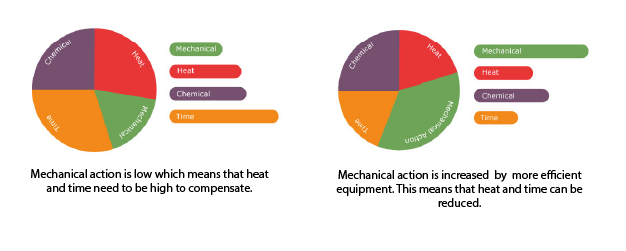
The hotter the system is, the more time is spent, the more detergent used and the higher the impact of the cleaning fluid, the better the clean will be.
- Heat can be introduced by warming the cleaning fluids, but this can be energy intensive.
- Time can be increase by either spending longer on the washdown process or by using foams which, when applied, will cling to the surface.
- Chemical action can be increase by using detergents of the correct type – this will depend on the residue being cleaned.
- Mechanical action can be increased by manual scrubbing or by using higher pressure water jet systems.
Although simple water can be effective in cleaning in most food hygiene processes detergents will be added to increase chemical action.
Common cleaning chemicals include:
- Alkaline detergents: highly effective against fats, proteins, and grease. Caustic soda-based products are a workhorse in meat and dairy plants
- Acidic detergents: used to tackle mineral deposits, scale, and protein films. Often used in brewery and dairy CIP (Clean-in-Place) systems
- Enzymatic cleaners: break down specific soils biologically. Useful for complex organic residues.
- Foam cleaners: many cleaning agents can be mixed with foaming agents and applied via foam lances. The foam clings to vertical surfaces, extending contact time.
Equipment used in cleaning
Washdown hoses and guns: these can be run at mains pressure (2-3 bar) or with pump boosted pressure (up to 150 bar). Higher pressure systems will give more impact cleaning for dislodging tough residues.
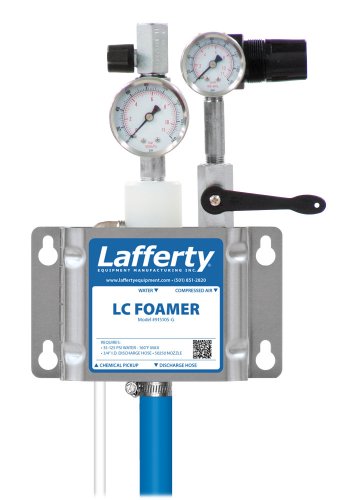
Foam application systems: these systems will mix a foaming agent with a mains water supply to produce the desired foam through a special foaming lance or spray gun. Foaming units can be wall mounted, wheeled mobile units or even mixed
directly.
CIP systems: automated pipe and vessel cleaning that circulates detergent solution without disassembly. Common in brewing, dairy, and beverage facilities.
Rotary spray heads and tank-cleaning nozzles: for the internal cleaning of vessels and tanks.
Heating systems: the wash water in many washdown systems will be heated to improve the cleaning action.
Once cleaning is complete, a thorough rinse with potable water removes all detergent residues, although there are many no-rinse detergents available which breakdown naturally and leave no harmful residues.
SANITISING
Sanitising reduces the number of bacteria on a surface to levels considered safe by public health standard. In the UK this normally means food contact surfaces require that 99.999% of target bacteria are eliminated this is a 5-log reduction. This is the
level required for food contact surfaces, and it is where many food factory hygiene programmes focus their day-to-day efforts.
Note: For high-risk environments, a 6-log pathogen kill (99.9999%) will be required.
However, and this is a critical point, sanitising is effective primarily against bacteria. According to the Food Standards Agencies definitions, sanitisers are not required to demonstrate efficacy against viruses and they
are not effective against bacterial spores. So, while sanitising is highly effective for controlling common food safety pathogens like Salmonella, E. coli, and Listeria, it does not offer the broader spectrum kill that disinfection
provides.
Sanitisers are specifically formulated and approved for use on food contact surfaces, and many are designed to be used without a subsequent water rinse meaning no harmful residues remain on the surface at the concentrations applied.
Common sanitising chemicals include:
- Food-grade QAC-based sanitisers (Quaternary Ammonium Compounds): approved for no-rinse use at low concentrations on food contact surfaces. Effective against a broad range of bacteria.
- Dilute chlorine-based sanitisers: sodium hypochlorite solutions at around 100–200 ppm for food contact use.
- Dilute peracetic acid (PAA) solutions: widely approved as no-rinse sanitisers, particularly effective in wet environments like meat and poultry processing.
- Electrolysed water (hypochlorous acid): generated on-site, food-contact safe, and increasingly popular as an environmentally friendly option.
- Foaming agents: many of the chemicals above can be mixed with a foaming agent to produce a sanitising foam that clings to surfaces, increasing dwell time and hence pathogen kill rates.
Equipment used in sanitising
- Low pressure spray lances: high impact is not required in sanitising as impact is used only to dislodge residue and this should already have been done prior to sanitising.
- Foam systems for generating and applying sanitising foams to increase dwell time.
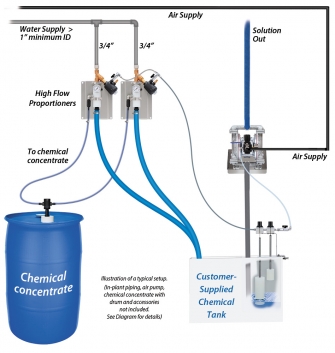
- Chemical dosing systems: inline dosing units ensure accurate, consistent dilution ratios automatically.
- Spray arch systems: used at personnel entry points to sanitise boots and lower clothing.
- Dip trays and boot wash stations: simple but effective contact sanitisers at production entry and exit points.
- Fogging and misting systems: can deliver sanitiser across entire rooms and into every nook and cranny as a final step before production restarts.
DISINFECTION
Moving up the scale, we come to disinfection, a higher level of microbial control than sanitising.
Where a sanitiser targets bacteria, a disinfectant kills a much broader spectrum of microorganisms, including bacteria, fungi, and critically, viruses. This makes disinfection the appropriate response when there
is a known or suspected viral contamination risk, or when a more thorough kill is required beyond routine production hygiene.
Disinfectants are typically used at higher concentrations than sanitisers, and unlike many food-contact sanitisers, they will usually require a thorough rinse with potable water afterwards before a surface can be used for food production because
the concentrations needed for disinfection can leave residues that are unsafe for food contact.
It's also worth noting that disinfection still does not reliably destroy bacterial spores, which are extremely resistant structures that some bacteria form under stress. That requires a further step, which we'll come to shortly.
Common disinfectant chemicals include:
Many of the same chemicals that are used in sanitising systems are also used in disinfection processes but just at higher concentrations. This almost always means that a through rinse is required afterwards as, when used in these concentrations, potentially
harmful residues will be left behind.
- Higher-concentration chlorine-based disinfectants: sodium hypochlorite at elevated concentrations delivers fast, broad-spectrum kill including against viruses.
- Peracetic acid at disinfecting concentrations: effective against bacteria, viruses, yeasts, and moulds. Breaks down into water and acetic acid, so relatively low environmental impact.
- Hydrogen peroxide: a strong oxidiser with broad-spectrum efficacy including against viruses. Often used in combination with PAA.
- Quaternary ammonium compounds (QACs) at disinfecting concentrations: effective against a wide range of bacteria and enveloped viruses, though less effective against non-enveloped viruses.
- Iodophors: iodine-based disinfectants with broad-spectrum activity, commonly used in dairy and beverage applications.
Equipment used in disinfection
- Low-pressure spray lances: allow broad, even application across large surface areas with controlled contact time.
- Trigger sprayers and manual applicators: for targeted treatment of hand-contact surfaces, handles, door push plates, and control switches.
- Recirculation and fogging systems: used to treat large areas such as cold stores, changing rooms, or processing rooms with disinfectant mist.
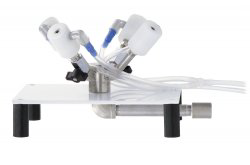
- Automated dosing and dispensing systems: ensuring correct concentration every time, removing the risk of human error in dilution.
STERILISATION
At the top of the scale, we have sterilisation which is the complete elimination of all microbial life.
This includes not just bacteria, viruses, and fungi, but also bacterial spores - the most resistant form of microbial life, capable of surviving conditions that kill everything else. Sterilisation is an absolute: a sterilised surface
or product contains no viable microorganisms whatsoever.
In a food factory, sterilisation is not applied to the general production environment. Instead, it is used in specific, validated applications where the complete absence of microbial life is required, most commonly in aseptic processing,
such as UHT milk, shelf-stable juices, or extended shelf-life ready-to-eat products.
Methods used in sterilisation
- Steam sterilisation, Steam-in-Place (SIP): superheated steam at 121°C or above is circulated through pipework, vessels, and filling systems for a defined time. Both the temperature and duration are tightly validated.
- High-Temperature CIP: circulating caustic or acid solutions at elevated temperatures to achieve sterilising conditions within closed systems.
- Hydrogen peroxide vapour (VHP): used in aseptic filling machines to sterilise packaging materials and filling heads before product contact.
- Peracetic acid at sterilising concentrations and temperatures: used in aseptic CIP systems where validated to achieve full spore kill.
- UV radiation: used in some applications such as treating water or sterilising packaging surfaces.
Equipment used in sterilisation
- SIP systems: automated steam injection and circulation systems with validated, calibrated temperature probes and logged process data.
- Aseptic filling machines: self-contained environments with integrated sterilisation of both the product pathway and the packaging material.
- Autoclaves: used in laboratory settings and some niche food applications.
- VHP generators: for room or equipment sterilisation in pharmaceutical-grade food environments.
SUMMARY
So, to summarise:
Cleaning removes physical soils and prepares the surface. Without it, nothing else works properly.
Sanitising reduces bacteria on food contact surfaces to safe levels but is not reliably effective against viruses or spores.
Disinfection goes further, killing bacteria and viruses across a broader spectrum but does not reliably destroy bacterial spores.
And sterilisation is the complete elimination of all microbial life, including spores reserved for aseptic processing environments and critical product pathways.
CONCLUSION
The right choice of level depends on the risk, the surface and the context. Day-to-day production hygiene typically demands cleaning and sanitising. A viral contamination incident may call for full disinfection. Aseptic product lines require validated sterilisation.
Note, in UK food safety guidance, particularly from the Food Standards Agency, the term sanitiser is often used to describe a product that both cleans AND disinfects.
However, in hygiene engineering and microbiology, there is a distinction between sanitising, typically a 5-log bacterial reduction, and disinfection, which provides a broader spectrum kill including viruses.
Understanding where each process sits in the hierarchy, and why, is what separates a hygiene programme that looks good on paper from one that genuinely protects your product, your people and your customers.