May 12, 2026, 10:06 AM
by
Catherine Lees
.png?sfvrsn=e4fccb92_1)
Raising the Bar on Food Safety: How Lafferty Equipment Can Transform Washdown and Hygiene in Food Factories
A guide for food production managers, quality assurance teams, and hygiene specialists
Food manufacturing facilities operate under some of the most demanding hygiene requirements of any industry. Whether a plant is producing ready meals, dairy products, meat, beverages or baked goods, the ability to clean down quickly thoroughly and consistently is not just a matter of good practice, it is a legal and regulatory obligation. Pathogens, allergen cross-contamination and biofilm formation are ever-present risks and a single hygiene failure can result in product recalls, reputational damage and serious harm to consumers.
For decades Lafferty, a manufacturer based in Arkansas, has been quietly solving these problems with a range of purpose-built chemical dispensing washdown and foam cleaning systems. Trusted by food processors across North America and increasingly across the world, Lafferty’s equipment is designed around one core principle: delivering the right chemical at the right dilution at the right time, every time. For food factories looking to tighten their hygiene protocols, reduce chemical waste and cut cleaning time, Lafferty’s product range offers serious solutions.
The Foundation: Venturi Mixing Technology

At the heart of much of Lafferty’s product line is the Venturi mixer, a deceptively simple device that underpins almost everything else the company makes. A Venturi mixer works by using the pressure and flow of water passing through a narrow restriction to create a vacuum that draws concentrated chemical into the water stream. The result is a precisely diluted solution produced on demand without the need for electricity pumps or complex dosing equipment.
In a food factory setting this matters enormously. Manual mixing of cleaning chemicals is notoriously inconsistent. Operators working under time pressure may add too much or too little concentrate leading either to wasted chemical and elevated costs or to under-strength solutions that fail to sanitise surfaces effectively. Lafferty’s Venturi systems eliminate that variability entirely. Each unit is calibrated to deliver a specific dilution ratio so the operator simply turns on the water and the correct solution is produced automatically.
Venturi mixers are also inherently safer than manual dilution. Food factory staff are not required to handle neat concentrate at point of use which reduces the risk of chemical burns or inhalation. Because the systems are water-powered they can be installed almost anywhere there is a water supply and a drain which makes them highly flexible for retrofitting into existing facilities.
Washdown Lances: Power and Precision at the Nozzle
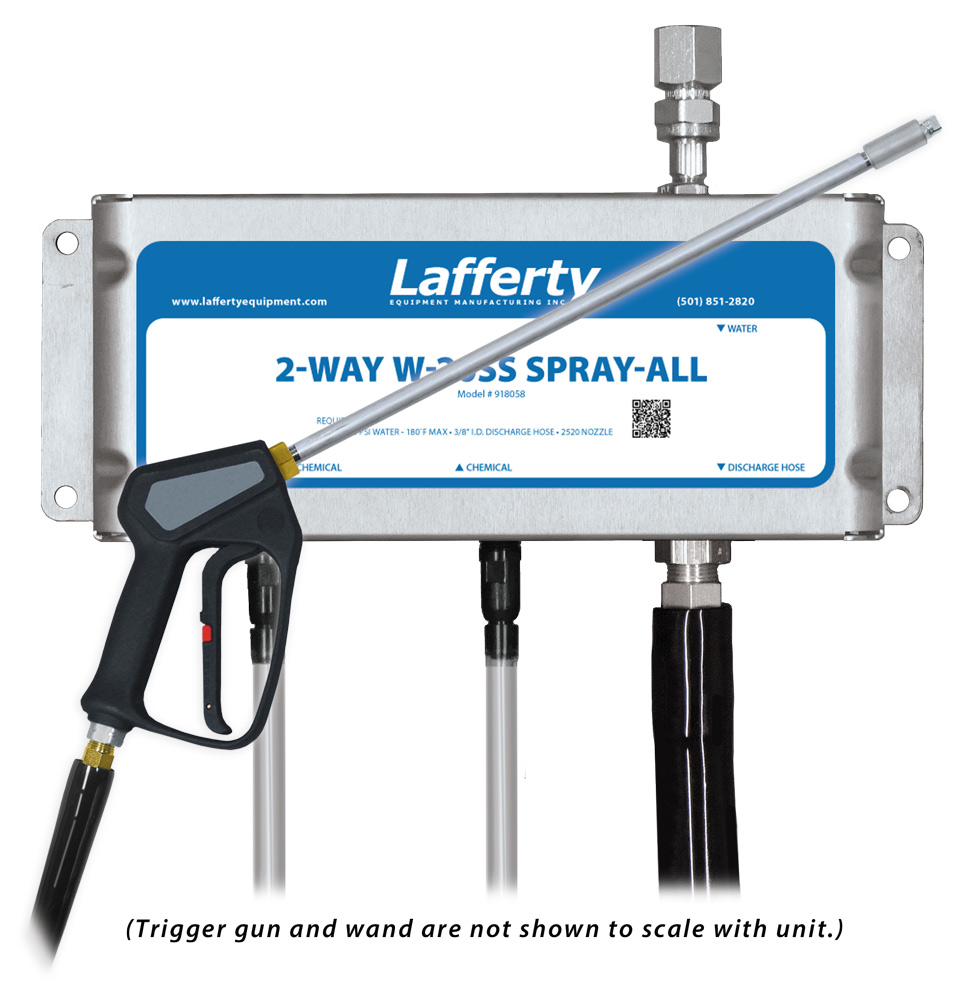
In any food production environment the washdown lance is the most hands-on piece of cleaning equipment on the floor. A poorly designed lance that delivers inconsistent pressure, drips when not in use or requires awkward two-handed operation quickly becomes a source of frustration and incomplete cleaning.
Lafferty’s washdown lances are built for the realities of industrial food environments. Constructed from materials suited to daily exposure to water detergents and sanitisers they are available in a range of configurations to suit different applications from gentle rinsing of delicate equipment to high-impact blasting of heavily soiled surfaces. Many models incorporate foam capability which allows the operator to switch between a high-pressure water rinse and a foamed detergent application from the same unit. This saves time and reduces the number of separate steps in a cleaning procedure.
Critically, Lafferty lances deliver chemical at a consistent pre-set dilution throughout the cleaning cycle. There is no drift in concentration as a container empties and no need for the operator to make judgements about chemical strength. For HACCP-conscious production managers this consistency is invaluable when documenting and auditing cleaning procedures.
Conveyor Cleaners: Tackling One of the Biggest Challenges in Food Processing

Conveyors are among the most contamination-prone surfaces in any food factory. They accumulate product residues, fats, sugars, proteins and moisture over the course of a production shift which creates ideal conditions for bacterial growth and, in some cases, the formation of persistent biofilms. Yet conveyors are also awkward and time-consuming to clean. Their length, their inaccessible undersides and the variety of belt materials and construction styles make manual cleaning unreliable.
Lafferty’s range of conveyor cleaners addresses this challenge with fixed or semi-fixed spray systems that apply detergent, foam or sanitiser across the full width and underside of a belt as it moves. Rather than relying on an operative working along the length of the conveyor with a lance, the Lafferty system applies chemistry evenly and automatically to every part of the belt surface as it passes through the cleaning zone. This approach is not only more hygienic, it is significantly faster which allows cleaning cycles to be completed in a fraction of the time required by manual methods.
The ability to integrate conveyor cleaners into production schedules is another significant advantage. Some food factories run brief mid-shift sanitation cycles on conveyors carrying high-risk products. A Lafferty system can be designed to activate automatically, apply a pre-set volume of chemical rinse and shut off, allll without requiring staff to stop production and enter the cleaning zone. For facilities under pressure to maximise production time while maintaining hygiene standards, this kind of automation is a genuine operational benefit.
Mobile Cleaners: Flexibility Across the Facility
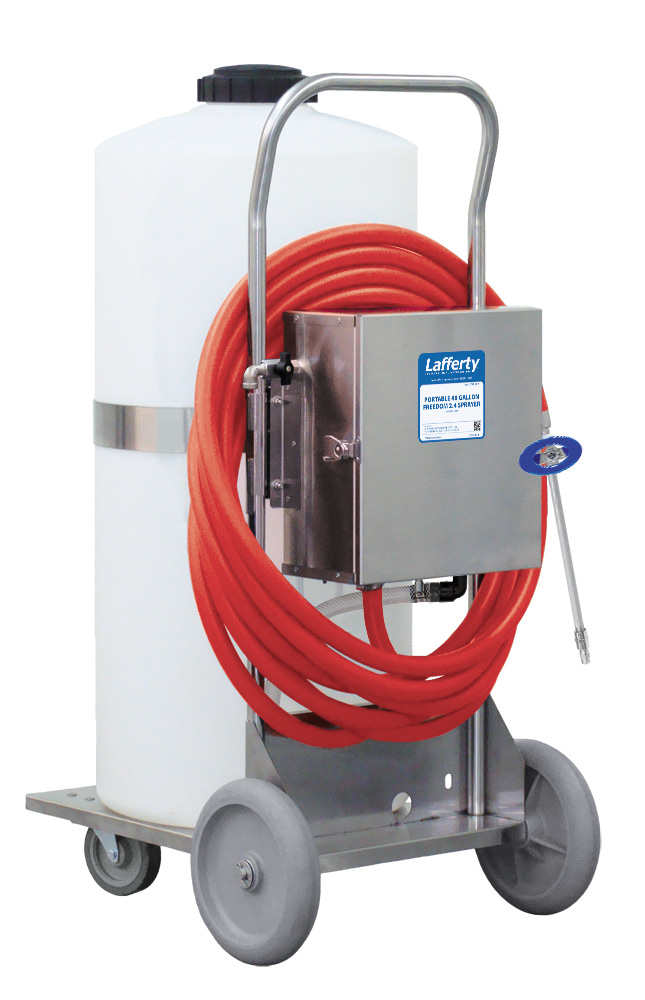
Not every cleaning task in a food factory is fixed in one location. Drains, walls, ceilings loading bay areas, external yards and equipment that is moved between shifts all require cleaning, often using different chemicals and different application methods. Mobile cleaning units from Lafferty are designed to bring consistent chemical dispensing and application capability to any part of a facility without requiring a fixed water and chemical supply at every point.
Mounted on robust trolleys or carts, Lafferty’s mobile cleaners typically incorporate a Venturi mixing system, a chemical supply and a hose and applicator which allows operatives to move to the task rather than bringing the task to the equipment. This is particularly useful in larger facilities where running permanent pipework to every cleaning point would be cost-prohibitive or in areas where the cleaning requirement is intermittent rather than routine.
Mobile systems also give facilities the flexibility to use different chemicals for different tasks from the same piece of equipment simply by switching the chemical container and confirming the correct dilution setting. This reduces the number of dedicated units required on the floor and keeps capital costs manageable while still ensuring that the right product is used at the right strength for each application.
Foaming Systems: The Case for Dwell Time
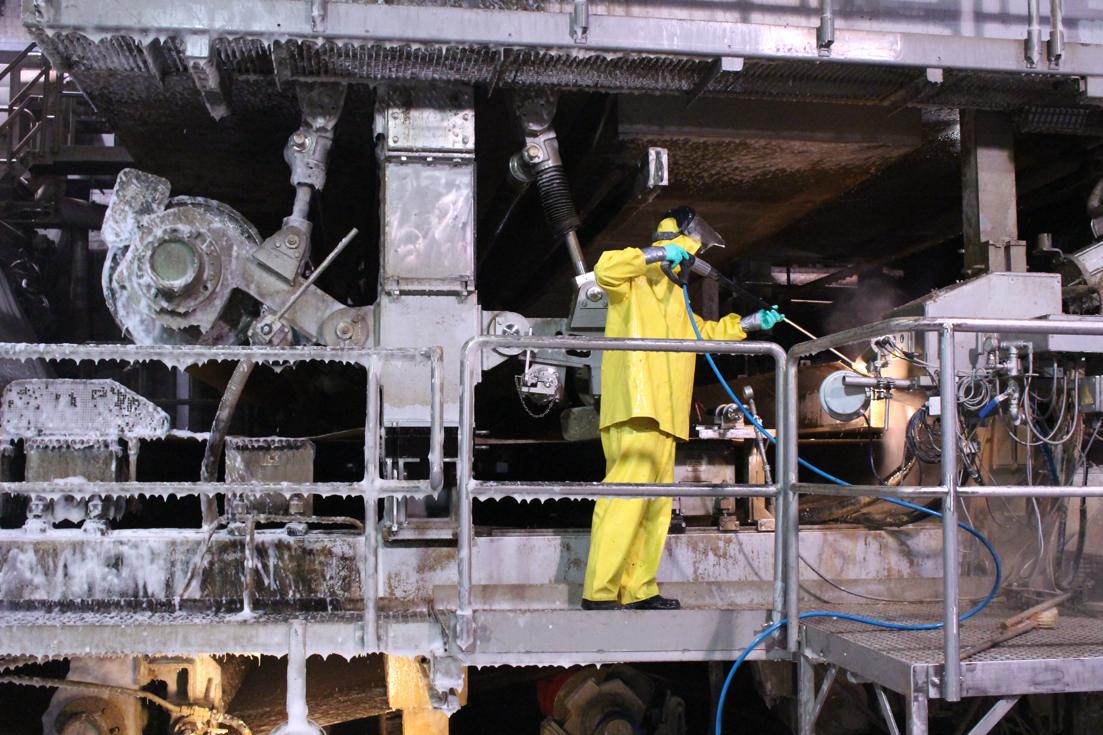
One of the most effective tools in the food factory cleaning arsenal is also one of the most visually distinctive: foam. When a detergent is applied as a thick clinging foam rather than a spray or liquid it adheres to vertical surfaces, equipment undersides and complex geometries far more effectively than a liquid rinse. This extended contact time known as dwell time allows the chemistry to penetrate and break down organic soiling biofilms and stubborn residues that would resist a quick spray-and-rinse approach.
Lafferty’s foaming systems generate high-quality stable foam using compressed air and water in combination with the company’s Venturi mixing technology. The result is a foam that clings in place for several minutes which ensures consistent chemical contact across the entire treated surface before rinsing commences. For food factories dealing with fatty deposits from meat or dairy processing or sugary residues from beverage or confectionery production, the difference between foam application and a liquid spray can be significant in terms of cleaning efficacy.
Beyond the microbiological benefits, foam application also has a practical advantage. It makes cleaning verification straightforward. Operatives and supervisors can see at a glance which surfaces have been treated and which have been missed which reduces the risk of areas being overlooked during a busy cleaning shift. When rinse water runs clear after foam removal there is a visible indicator that the cleaning process has been completed. A simple but useful checkpoint in any hygiene protocol.
Lafferty offers both hand-held foaming applicators and fixed foaming systems for areas that require regular standardised treatment which gives food factories the flexibility to build foam cleaning into their standard operating procedures at whatever scale is appropriate.
Fogging Systems: Reaching Where Other Methods Cannot

Even the most thorough wash-and-foam cleaning procedure leaves some surfaces and spaces difficult to treat effectively. High-level pipework ceiling voids inside ventilation ducts, the internal surfaces of enclosed equipment, cold store interiors and areas behind fixed machinery can all harbour contamination that hand-cleaning methods struggle to reach. This is where fogging comes into its own.
Lafferty’s fogging systems produce a fine mist of chemical solution that travels through the air and settles on all exposed surfaces within a defined space regardless of their accessibility. Fogging is particularly valuable for disinfection and sanitisation rather than degreasing. The very fine droplets carry sanitiser to surfaces that would otherwise go untreated which dramatically reduces the overall microbial burden in a room or piece of equipment.
In food factories where airborne contamination is a concern such as those producing chilled ready-to-eat products particularly vulnerable to listeria, regular fogging of production areas during downtime can form a critical layer of protection within a multi-barrier hygiene strategy. Fogging can also be used for odour control mould prevention in high-humidity environments and pest control applications in certain contexts.
Because Lafferty fogging systems use the same Venturi mixing principles as the rest of the product range, chemical dilution is consistent and controllable and the systems can be operated by standard factory personnel without specialist training.
Building a Joined-Up Hygiene Programme
The real value of Lafferty’s product range for food factories lies not just in the individual performance of any single piece of equipment but in the coherence of a joined-up cleaning programme built around the same underlying technology and philosophy. When Venturi mixing, washdown lances, conveyor cleaners, mobile units, foaming systems and fogging equipment are all calibrated to work with the same suite of cleaning chemicals at pre-validated dilutions, a food factory can develop hygiene procedures that are genuinely standardised, auditable and repeatable.
This matters more than ever in an era of increasing scrutiny from retailers, auditors and regulators. Standards such as the BRC Global Standard for Food Safety, SQF and IFS place growing emphasis on documented validated cleaning procedures and the ability to demonstrate consistent chemical efficacy. A facility equipped with Lafferty systems can demonstrate that every cleaning step is carried out at the correct chemical concentration for the correct contact time using equipment that has been validated for the purpose. This is a far stronger position than one where cleaning relies on manual dilution and operator judgement.
Conclusion
Food factory hygiene is too important and too complex to be left to chance. Every shortcut in cleaning procedure, every inconsistency in chemical dilution and every surface left inadequately treated represents a potential pathway for contamination recalls and harm. Lafferty’s range of Venturi mixers, washdown lances, conveyor cleaners, mobile cleaning systems, foaming equipment and fogging systems offers food processors a practical proven and cost-effective means of raising the standard of their cleaning operations across the board.
By taking the guesswork out of chemical dilution, extending cleaning capability to difficult-access areas, cutting cleaning times and producing systems that can be audited and validated with confidence, Lafferty helps food factories meet the hygiene standards their customers and regulators demand while freeing up their most valuable resource production time to focus on what they do best.
Visit our Washdown page for more information.