The answer to this question depends heavily on the tank cleaning head being used. The first question to ask is why would you need filtration at all? Isn't clean, filtered water being used for cleaning tanks and in the final rinse? The answer is yes. Not a lot of filtration will be required for the final stage of the clean. For the majority of the other tank clean stages, recirculated water will be used to save on water.
In those situations, the particulates from the previous tank clean, from pips and stalks and whatever else is in that tank, for example, often find their way into the wash system. Therefore, it is vital to ensure that the water is filtered before it gets to the tank cleaning head, otherwise clogging and problems can occur.
So, what level is required? What kind of particulate content can the different types of tank cleaners handle or enable to pass through them?
Standard spherical spray balls will typically have holes between 1 mm and 2.5 mm in diameter. Any particulate entering the system that's bigger than 1 mm is going to get trapped within the spray balls and build up over time and cause clogging.
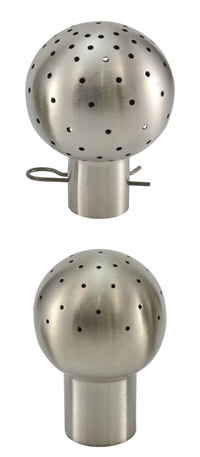
Upstream filtration that is significantly smaller than the orifice sizes (the hole sizes on the spray balls), would be recommended here to prevent such an issue from occurring.
A 50 mesh filtration would normally be the choice as it has 0.3 mm holes in the filter which would eliminate any clogging, even with 1 mm holes in smaller spray balls.
Moving on to bigger spray balls with 2 mm or 2.5 mm holes in them, a 25 mesh, which is 0.7 mm for filtration, would more than likely suffice.
Clog-resistant alternatives such as non-moving static tank cleaning heads are also available.
Other alternatives to the traditional spray ball that require even less filtration are another option.
Very wide angle spiral nozzles can have a spray pattern of up to 270 degrees and are naturally clog resistant. They were originally designed to spray slurries and typically have a free passage of around 3 mm to 5 mm. Particles between 3 mm and 5 mm could technically pass through these nozzles fine.
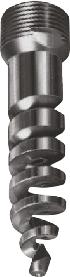
Something a bit smaller would still be recommended in terms of filtration, just to be on the safe side. But a 10 mesh or 2 mm filtration would be sufficient to filter out any large pieces of material such as stalks, etc. The smaller ones can pass happily through the filter and the spiral nozzle.
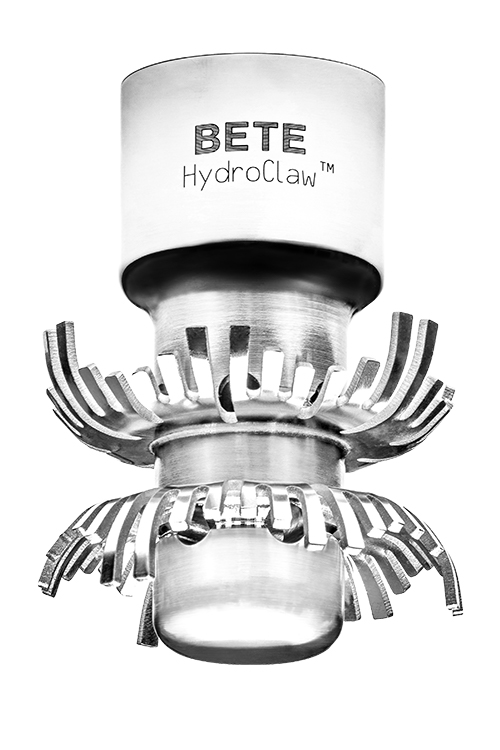
Another design that recently came onto the market is the HydroClaw from BETE Fog Nozzle. This is a unique, patented tank washing nozzle that is specifically designed to be clog resistant.
The design has a huge free passage of around 7 mm, meaning it can pass objects about three to four times bigger than that of a standard spray ball. In most cases, the very large objects that may find their way into the wash system just need to be filtered. So a 10 mesh or 2 mm filtration is more than adequate for a nozzle of this size. In most cases, having no filtration at all can also be a possibility.
Next up are spinning spray balls.
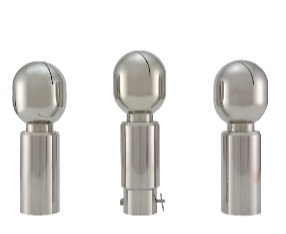
The slots on the spinners are reasonably large, especially in comparison to the holes in spray balls. This can make it seem like these types of tank cleaner are more clog resistant than spray balls. The reality is, they're not. This is because they run on a ball bearing system as they spin.
Any particulate can get into that ball bearing system and gum it up and stop it spinning.
50 mesh filtration or better would be advised for these spinners because they can gum up quite easily; small bits of grit can build up in the workings and stop them from spinning over time. So 50 mesh or 0.3 mm filtration means any objects above 0.3 mm will be filtered out as a result.
For rotary jet cleaners, it's a similar story.
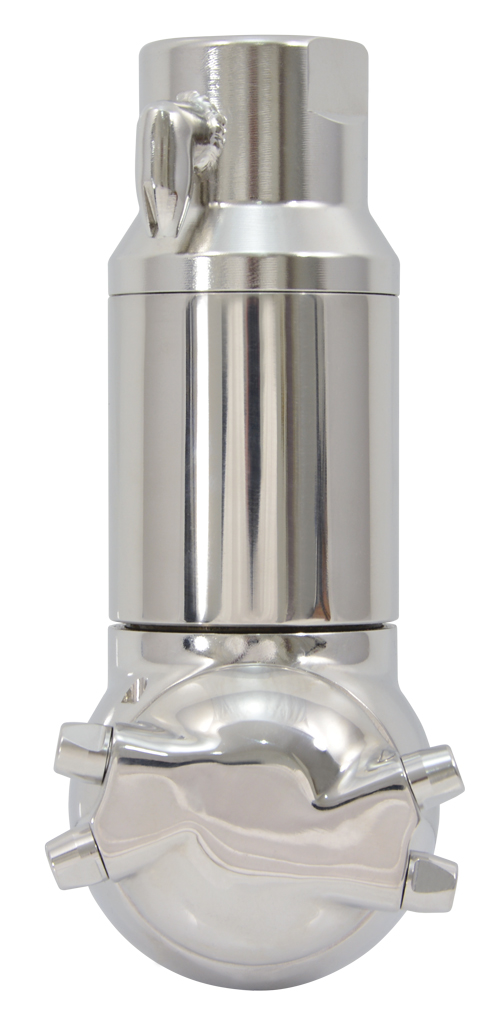
The jet orifices themselves are rather large (ranging between 2–3 mm and anything up to 12 mm or 14 mm for the extra-large ones in diameter), and should be able to pass through bits of grit and sand quite easily. However, the wash fluid itself comes into contact with the internal gears within these tank cleaners, and it's necessary to clean the gears and keep the internals of the tank cleaner self-lubricating and self-cleaning.
The filtration needs to be considered very carefully on these systems, despite the larger nozzle size. So, 50 mesh filtration or better would be advised here to remove particles much above the 0.3 mm size. This will stop the gears from gumming up over time.
It is very common for tank cleaners to stop working due to stuff working its way into the mechanisms because they're open to the wash fluid. However, there is a clog-resistant version of these available on the market.
These standard jet cleaners have greased internal gearboxes, which are not exposed to the wash fluid, and this means they can't be a truly hygienic tank cleaning system. Because of this, they wouldn't be suitable for use in food processing, etc.
We sell a lot of them into the storm tank cleaning market, for example. And because the gears and internals are no longer coming into direct contact with the washer fluid, grit and sand, and even small bits of rock can pass through the internals of the nozzle quite easily.
The goal is to filter out the large stuff to prevent sticks and algae from getting in and messing the system up over time.
10 mesh, 2 mm filtration is more than adequate for most of these styles of tank cleaners. Filtration does not need to be a big concern as long as the big stuff is being removed.
But for industrial, non-hygienic tank cleaning processes, they're absolutely fine.