Hand hygiene is one of the most important controls in food manufacturing. Most manufacturers have documented procedures, training programmes and decent washing facilities in place. Getting a consistent standard of handwashing out of that set-up is another matter, because the result depends so heavily on the person doing it.
A sink or wash station gives employees the opportunity to wash their hands correctly. It doesn't guarantee they will. Technique, wash duration and compliance vary from one employee to the next and from one shift to the next.
For manufacturers under growing food safety, audit and production pressure, the real challenge isn't providing handwashing facilities. It's getting a consistent process that delivers consistent results.
At SNP, we usually talk about cleaning systems in terms of Sinner's Circle and sanitising systems in terms of the four elements needed for effective sanitisation.
Hand hygiene sits across both. Dirt, grease and other contamination need to come off the skin before sanitising chemistry can get to work on whatever microorganisms are left. Wash first, then sanitise – the same logic that applies to tanks, conveyors and processing equipment applies to hands.

Hand hygiene combines both processes. In many respects, effective hand hygiene can be viewed as the point where cleaning and sanitising overlap. Before pathogens can be reduced to safe levels, dirt, grease and other contamination must first be removed from the skin surface. Only then can sanitising chemistry come into effective contact with any remaining microorganisms.
As a result, many of the same principles that apply to cleaning tanks, conveyors and processing equipment also apply to hand hygiene.
The Four Elements of Effective Hand Hygiene
Surface preparation
Effective sanitising starts with effective cleaning. Oils, grease and other residues shield microorganisms and reduce how well sanitising agents can work. If hands aren't cleaned properly first, getting the pathogen reduction you need becomes much harder.
CoverageEvery part of the hand needs treating – fingertips, nail beds, thumbs, the backs of hands. These are the areas most often missed in manual handwashing and anywhere the process doesn't reach stays a potential source of contamination.
DosingHygiene chemistry needs to be dosed correctly. Too little and it won't do the job properly; too much and you're just burning through chemical unnecessarily and adding cost.
Dwell timeContact time matters. The chemistry needs to stay on the skin long enough to do its job – cut it short and effectiveness drops, drag it out and you lose productivity. It's a balance, same as most sanitising steps.
The Challenge of Consistency
The theory behind good hand hygiene is well understood. Applying it consistently, shift after shift, employee after employee, is the hard part.
It's a theme that comes up again and again: inconsistent technique, reliance on individual behaviour, the burden on supervisors to keep monitoring it, rising employee numbers, ongoing training and having something to show an auditor.
Why Does Consistency Matter?
Manufacturers don't care about wash technique or duration for its own sake. What they care about is compliance.
Food manufacturers work within tight regulatory, customer and audit frameworks – Brand Reputation Compliance Global Standards (BRCGS), customer standards, retailer expectations, internal quality systems. They need confidence that hygiene procedures are actually being followed on the floor, not just documented in a folder.
That's the gap: a documented procedure doesn't prove compliance. You can install a sink, run the training, put up the signage and the process still lives or dies on how consistently people actually carry it out. Hygiene managers end up spending a lot of time monitoring handwashing, chasing down compliance failures and looking for ways to cut the variation out of the process.
From Behavioural Control to Process Control
Traditional handwashing relies on behavioural control. Procedures have to be followed, employees have to be trained, supervisors have to keep checking. The process is only as good as the person doing it.
Automated handwashing systems take a different approach. They control the wash cycle itself – coverage is standardised, chemical application is controlled, wash duration is fixed. Hand hygiene stops being purely a cleaning issue and becomes a process control issue: build a system that delivers the same result every time and compliance follows.
Automated Handwashing Systems
Automated systems take the variables that affect hand hygiene – coverage, chemical application, wash duration – and control them within a defined wash cycle, cutting down the variation between users and shifts.
That's a big part of why they're becoming more common across food manufacturing, pharmaceutical production and other hygiene-critical environments.
The benefits customers report are usually operational as much as technical:
- More consistent handwashing standards
- Less dependence on individual technique
- Reduced supervisory monitoring
- Faster movement of staff into production areas
- Fewer queues at shift changes
- Simpler employee training
- More confidence in hygiene compliance
- Easier audit and certification support
For most clients, the value isn't just cleaner hands but knowing the process is being carried out properly every time, without having to check.
Meritech Automated Handwashing Systems
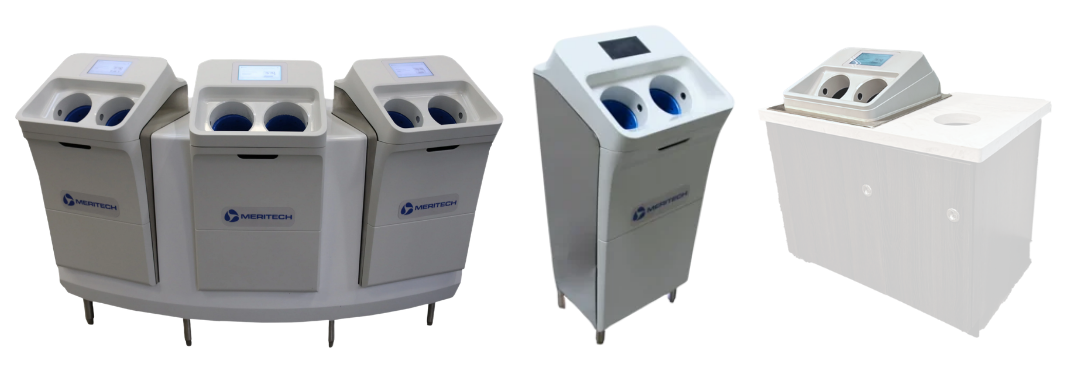
Meritech's CleanTech® range of handwashing machines is built around this idea of process consistency. The machines are simple to use and can be used at entry points, production transitions and high-risk zones to create consistent sanitation checkpoints.
How do Mertitech handwash systems work?
Users insert their hands into the machine where 40 nozzles, 20 in each hand hole, provide a pressurise spray which rotates around the hands 23 times. The total wash time is 12 seconds: 2 seconds with a potable water rinse, 4 seconds of hygiene solution and then 6 more seconds of potable rinse.
CleanTech systems perform genuine cleaning and sanitising, removing particles and contaminants, including allergens and salt. It is worth nothing they should not be treated as a replacement for heavy-soil removal e.g. heavy mud, grease or oil, paint, material trapped under fingernails and jewellery-related contamination.
The controlled wash cycle gives every user complete hand coverage, consistent chemical application and a fixed wash duration, standardising the process and taking the variation out of manual handwashing.
Where these systems have been adopted, the reported benefits are consistent: less supervision, better compliance, easier training, higher throughput, more confidence in the process overall.
The range includes compact single-user stations up to larger multi-user hygiene entry systems with footwear sanitising and compliance monitoring built in.