Hand hygiene is one of the most important controls in food manufacturing. Most manufacturers have documented procedures, training programmes and decent washing facilities in place but getting a consistent standard of handwashing - in terms of participation and of hygienic result - out of that set-up is another matter because the result depends so heavily on the person doing it.
A sink or wash station gives employees the opportunity to wash their hands correctly but it doesn't guarantee they will. Technique, wash duration and compliance vary from one employee to the next and from one shift to the next.
The real challenge for hygiene managers at companies under growing food safety, audit and production pressure is getting a consistent process that delivers consistent results.
At SNP, we usually talk about cleaning systems in terms of Sinner's Circle and sanitising systems in terms of the four elements needed for effective sanitisation.
Hand hygiene sits across both. Dirt, grease and other contamination need to come off the skin before sanitising chemistry can get to work on whatever microorganisms are left. The wash first then sanitise logic that applies to tanks, conveyors and processing equipment applies to hands.
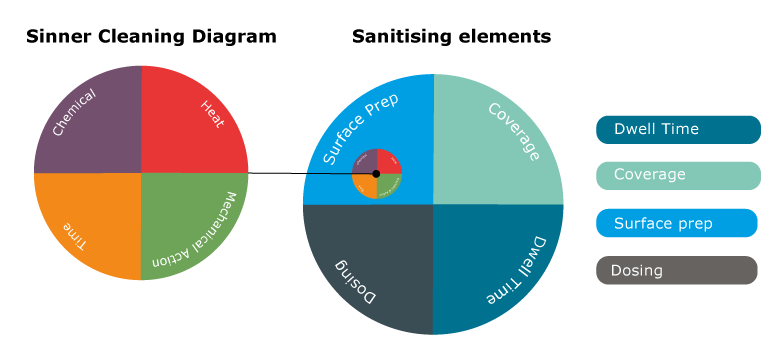
The Four Elements of Effective Hand Hygiene
Surface preparation
Effective sanitising starts with effective cleaning. Oils, grease and other residues shield microorganisms and reduce how well sanitising agents can work. If hands aren't cleaned properly first, getting the pathogen reduction you need becomes much harder.
Coverage
Every part of the hand needs treating – fingertips, nail beds, thumbs, the backs of hands. These are the areas most often missed in manual handwashing and anywhere the process doesn't reach stays a potential source of contamination.
Dosing
Hygiene chemistry needs to be dosed correctly. Too little and it won't do the job properly; too much and you're just burning through chemical unnecessarily and adding cost.
Dwell time
Contact time matters. The chemistry needs to stay on the skin long enough to do its job – cut it short and effectiveness drops, drag it out and you lose productivity. It's a balance, same as most sanitising steps.
The challenge of consistency
The theory behind good hand hygiene is well understood. Hands must be cleaned thoroughly, the hygiene solution must be effective and reach every surface at the correct concentration and it must remain in contact with the skin for long enough to reduce pathogens effectively. Ensuring all this consistently, shift after shift, employee after employee, is the hard part.
In conversations with our customers, it's a theme that comes up again and again: inconsistent technique, reliance on individual behaviour, the burden on supervisors to keep monitoring it, rising employee numbers, ongoing training and having something to show an auditor.
Compliance is why it matters
Manufacturers don't care about wash technique or duration for its own sake. What they do care about is compliance. Manufacturers work within tight regulatory, customer and audit frameworks e.g. Brand Reputation Compliance Global Standards (BRCGS), customer standards, retailer expectations and internal quality systems.
Hygiene managers need confidence that every required handwash is both completed AND effective. Proving that an employee visited a wash station is not enough. The wash itself must deliver the coverage, chemical dosing and contact time needed to reduce contamination. True compliance requires a controlled, verified process that delivers the right coverage, dosing and contact time every time, paired with digital cycle data that helps quality assurance (QA) teams audit shift compliances.
Of course, compliance is not the final benefit to companies. Its value is the commercial and operational risks it helps the business control:
Reduced financial risk from contamination
Effective, consistent handwashing lowers the likelihood of contaminated products, rejected batches, production stoppages, withdrawals and recalls — protecting revenue and avoiding the direct costs these events carry.
Protected existing contracts and stronger position for new business
Verifiable hygiene controls help satisfy customer and retailer requirements, safeguard approved-supplier status, and provide stronger evidence when pursuing new contracts — turning hygiene compliance into a commercial advantage rather than just a cost of doing business.
Reduced audit preparation and administration time
Digital hygiene records replace manual paperwork, so evidence is ready to retrieve in minutes rather than hours, cutting the staff time spent preparing for and managing audits.
Fewer non-conformities and corrective actions
A controlled, traceable process makes compliance easy to demonstrate, lowering the risk of audit findings and eliminating the follow-up work each finding creates.
Less time spent on supervision and compliance management
Automating the wash cycle and logging cycle counts frees managers from policing handwashing technique, chasing and checking manual records letting supervisors focus on quick spot-checks and shift-level audits rather than standing over the sink.
Production keeps moving, with no lost output
Fast, standardised handwashing gets employees into production areas without queues or delayed shift starts, protecting throughput and labour efficiency.
Brand reputation and customer confidence protected
Fewer hygiene failures means fewer incidents that could damage the trust and reputation the business has built around food safety and product quality, safeguarding customer relationships and market position.
From Behavioural Control to Process Control
With traditional handwashing procedures, all the effort goes towards behavioural control.
Poor hand hygiene is rarely just a training issue. It is usually driven by practical friction on the shop floor. When staff are under time pressure, standing at a manual sink for 20 to 30 seconds of scrubbing, rinsing and drying creates bottlenecks at shift changes and break times. Combined with harsh soaps that leave skin dry and sore after repeated washes, workers naturally start cutting corners.
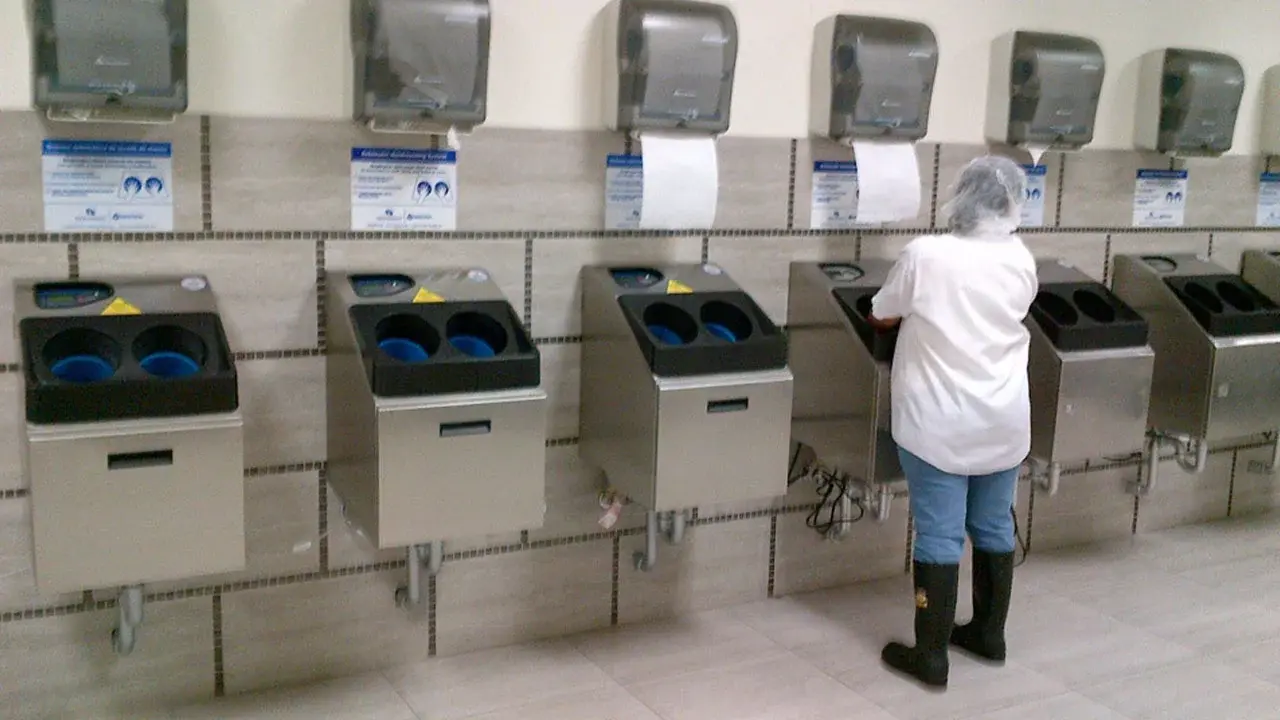
Automated handwashing systems take a different approach, controlling the wash cycle itself: coverage is standardised, chemical application is controlled and the wash duration is fixed. Hand hygiene becomes a process control issue - once hands are inside the cylinders, the system delivers the same result every time and cuts down or eliminates the variation in technique, temperature and chemical dosing across users and shifts.
Automated handwashing stations, such as the
CleanTech® range from Meritech, are built around this idea of process consistency. The machines are simple to use and can be used at entry points, production transitions e.g. between raw and ready-to-eat (RTE) zones and in other high-risk zones to create consistent sanitation checkpoints.
Removing the friction that causes staff to skip washes
CleanTech® station tackle the everyday deterrents directly:
- 12 seconds instead of 20–30: Cutting wash time by more than half removes the time-pressure excuse to rush or skip a wash during busy transitions.
- Warm, skin-friendly conditioning: CleanTech® uses warm water and EcoaPure solution containing skin conditioners, eliminating the dry, cracked hands that make staff reluctant to wash frequently.
- Clear visual countdown: A prominent 12-second timer replaces guesswork with a simple, predictable finish line, encouraging staff to stay until the cycle completes.
Enforcing Participation at High-Risk Transitions
As stated, automated wash stations remove human variation from the wash itself, controlling water pressure, nozzle coverage, chemical dosing, and cycle timing so every wash meets the same validated standard. However, for facilities that also need to enforce participation without stationing a supervisor at every sink, CleanTech® units can be interlocked with controlled-access turnstiles and footwear sanitising stations at critical entry points (such as raw-to-RTE transitions).
The benefits include:
- No time saved by rushing: The turnstile remains locked until the full 12-second cycle completes, removing the main incentive for staff to cut a wash short.
- Built-in accountability: Pairing the station with badge readers or gate relays ties hygiene events directly to zone entry, giving QA teams far stronger assurance at high-care boundaries.
- Lighter supervisory load: Supervisors can rely on shift-level cycle audits and occasional spot-checks rather than constant manual observation.
Find out more about Meritech's CleanTech® stations.