Spray Nozzle Troubleshooting Guide
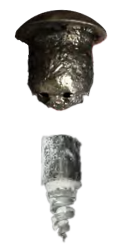
When a spray nozzle isn’t performing, the nozzle itself isn’t always the culprit. Poor pressure, a pump that can’t deliver the flow, or a nozzle that’s been knocked out of line can all look like a failed nozzle. Nozzles are precision parts, though, and even small amounts of corrosion, wear or build-up will change how they spray and will cause uneven spray coverage.
This guide covers common causes of spray problems and what to do about each one.
Start with the table below: find what you’re seeing, check the likely causes and jump to the section that matches. If you’re still stuck, our spray nozzle experts are happy to help.
| What you’re seeing | Likely causes | What to check | Problem No |
|---|
| Spray is weak, spluttering or sputtering | Poor fluid pressure, poor flow rate, clogging | Pressure at the nozzle (not the pump), pump capacity, filtration, pressure gauge at the spray bar | 7, 8, 4 |
| Flow is lower than expected | Clogging, poor pump sizing, pressure losses in the pipework | Blocked orifice, pressure drop calculations | 4, 7, 8 |
| Drop size is larger than expected | Low operating pressure, wear, corrosion | Pressure at the nozzle, orifice condition | 7, 3, 1 |
| Spray pattern is uneven or distorted | Clogging, caking, mechanical damage, corrosion, wear | Orifice for blockage, build-up or scratches | 4, 5, 6, 1, 3 |
| Build-up on the outside of the nozzle | Caking | Nozzle design (anti-bearding), material (e.g. PTFE), inspection frequency | 5 |
| Spray is going in the wrong direction | Poorly aligned nozzles | Nozzle orientation, thread fit, holder type, self-aligning fittings | 9 |
| Leaking at the thread | Mechanical damage from overtightening or repeated removal | Thread condition, tightening and refitting practice | 6 |
| Nozzle performance has dropped over time | Wear, corrosion, temperature damage | Material compatibility, operating temperature, inspection schedule, flow test individual nozzles | 3, 1, 2 |
| Nozzle looks deformed or damaged in a hot environment | Temperature | Manufacturer’s temperature chart for that material, heat shielding | 2 |
| Orifice looks scratched or enlarged after cleaning | Mechanical damage from incorrect cleaning | Cleaning method (no wire brushes or probes in the orifice) | 6 |
How to check your nozzles first
Before working through the causes below, a few quick checks will often tell you where to look.
Inspect the nozzle. A visual check can usually spot wear or corrosion and can show damage from installation or normal operation, though it isn’t always obvious.
Inspect the spray pattern. Streaks, heavy patches, fluttering or a lopsided spray all suggest a nozzle isn’t working as intended. What to look for depends on the nozzle type:
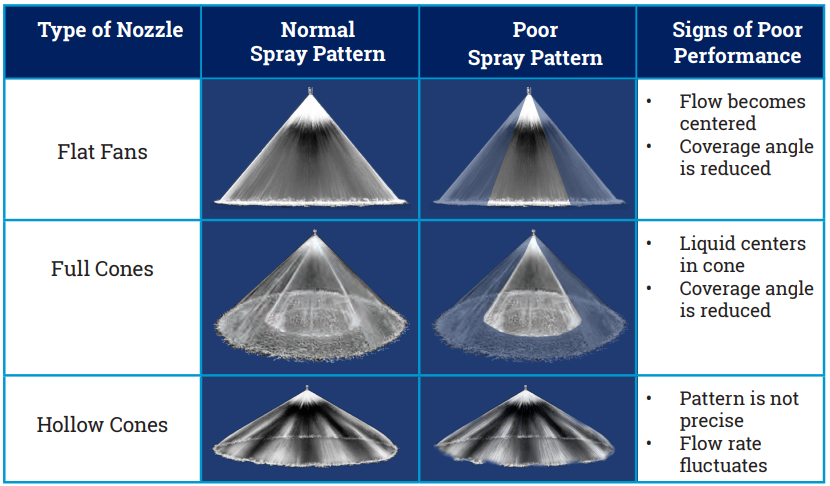
Check flow rate and pressure. Flow rate and operating pressure are directly linked for a given nozzle, so if either moves away from its nominal value, suspect clogging or excessive wear. See sections 7 and 8 for how to measure what the nozzle actually sees.
Watch overall system performance. A change in the results your system delivers, such as temperatures, pollutant levels or coverage, can point to a damaged, clogged or worn nozzle even when the nozzle looks fine.
If those checks point to a problem with the nozzle, the nine causes below cover what is usually behind it and how to put it right. They start with the nozzle itself (corrosion, temperature, wear, clogging, caking and damage) and then move to the supply system (pressure and flow) and alignment. If the nozzle looks fine but the spray is still wrong, jump to sections 7 and 8, because the problem is often upstream of the nozzle.
1. CHEMICAL CORROSION
Nozzles are precision parts and if they get corroded, even in a small way, they're not going to perform well. This will affect spray performance.
The solution: Material selection is very important. The environment must be assessed along with the corrosives and the correct material must then be selected for the spray nozzle.
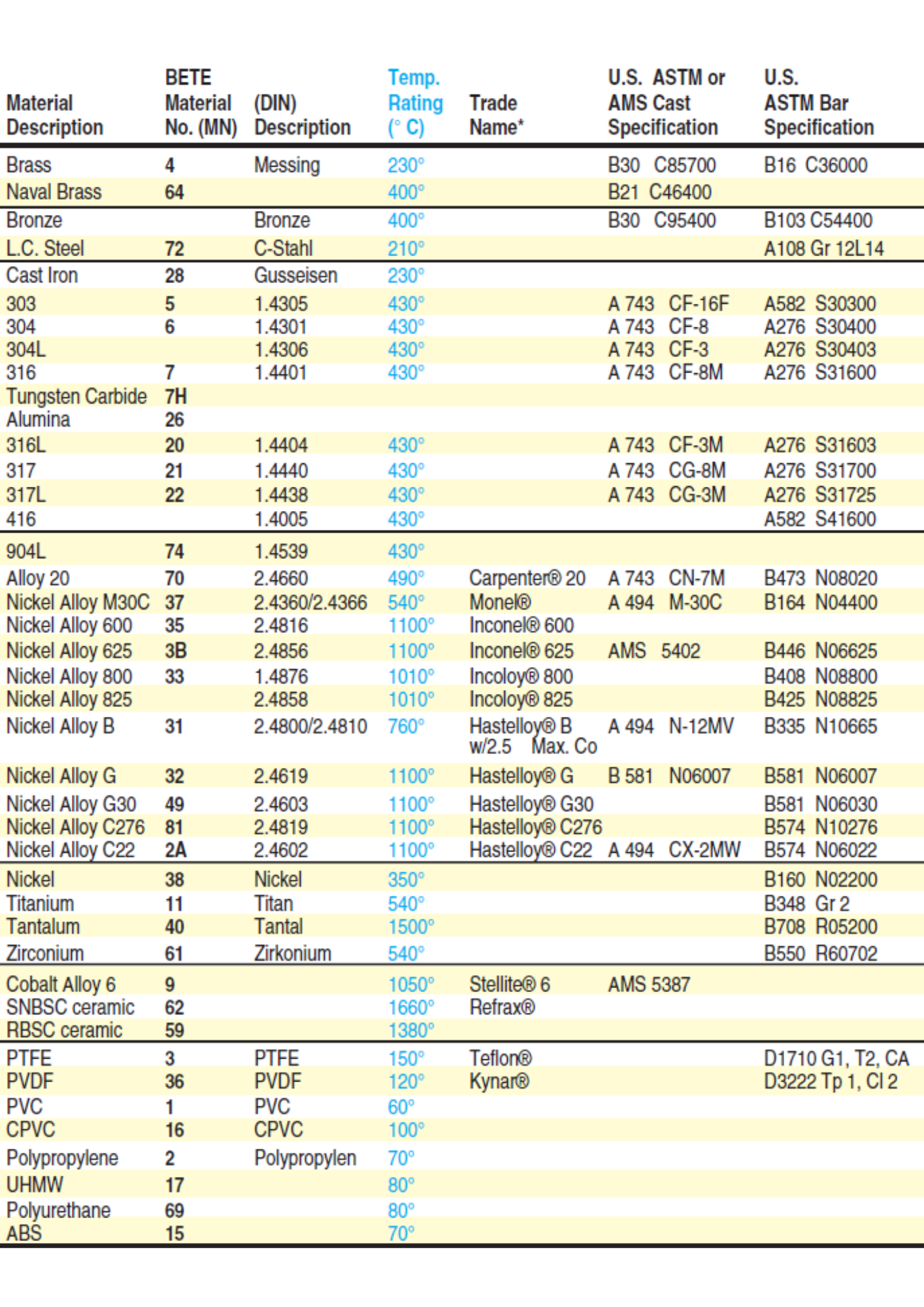
Corrosion occurs at different rates and temperatures, therefore the temperature of the environment must also be assessed to ensure the most suitable material is chosen. The material must be able to resist corrosion at that specific temperature.
2. TEMPERATURE
If the environment is too hot for the spray nozzle, this can cause some deformations within the spray nozzle; the smallest of deformations can cause big problems with the spray because, as mentioned before, spray nozzles are precision components.
The solution: Material selection is once again, very important.
If you’re spraying in a hot environment, it is also a wet environment by the very nature of the nozzle. When looking at compatibility charts, it’s essential to be careful and look at the ones from the spray nozzle manufacturer rather than general material temperature compatibility charts. The ones from the spray nozzle manufacturer will often be quite a lot lower because they’re geared towards actual spray nozzles rather than other more general components.
Another way of overcoming this problem is through heat shielding. Various heat shielding solutions can be looked at to protect the nozzle from the extremes of temperature.
3. MECHANICAL WEAR
This can either be caused by the fluid being sprayed through the nozzle itself or by external factors within the environment such as particulates within a gas flow.
The solution: Again, material selection is key.
In a high pressure/wear environment, harder and more robust materials for nozzles must be selected otherwise regular replacements will be required.
Whilst material selection reduces this, it won’t completely eliminate it. All nozzles are a wear part and the real solution to this is not only selecting the correct material, but also regular inspection of those nozzles and providing replacements when needed. Even with the hardest materials, they're still going to wear eventually.
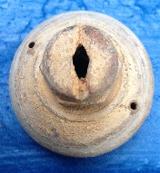
Wear rarely stops a system outright. It makes it less efficient. As a nozzle degrades, it needs cleaning more often, which means more downtime and higher running costs. We recommend ordering replacement nozzles before the old ones become completely ineffective.
Wear can also affect your product. In some applications, a degrading nozzle can shed material into the fluid or gas being sprayed. This can cause quality problems, fouling of equipment, or clogging of components downstream.
Worn nozzles are easy to miss because performance drops gradually. A flow tester takes the guesswork out of it: a programmable flow meter such as our SC2 Flow Meter can check nozzles one by one and show which are operating outside specification, so you replace only the ones that need it. Because nozzles are wear parts, it also pays to keep a full spare set on the shelf. Unused nozzles store well, and many are made to order, so waiting for a replacement can stop a line for far longer than the nozzle is worth.
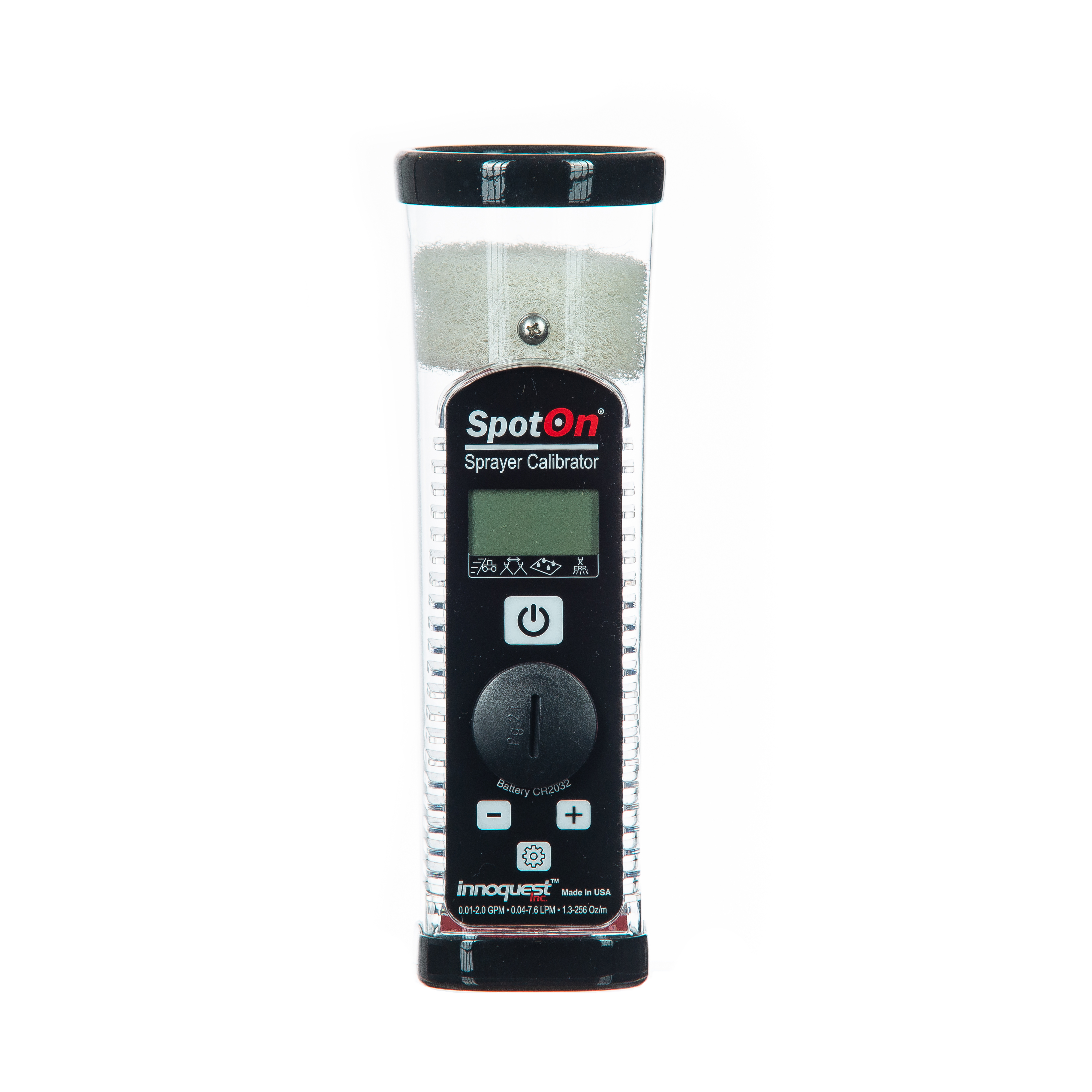
Inspect regularly and keep a log. As a guide, check high-use systems weekly and low-use systems monthly. Trends in the log will show wear developing before it affects your product.
4. CLOGGING
This is where particulates within a liquid build up within the nozzle and clog the orifice. This will obviously cause poor spraying.
The solution: Source better filtration and use clog resistant nozzles such as spiral nozzles or our MP nozzles that have naturally clog resistant designs.
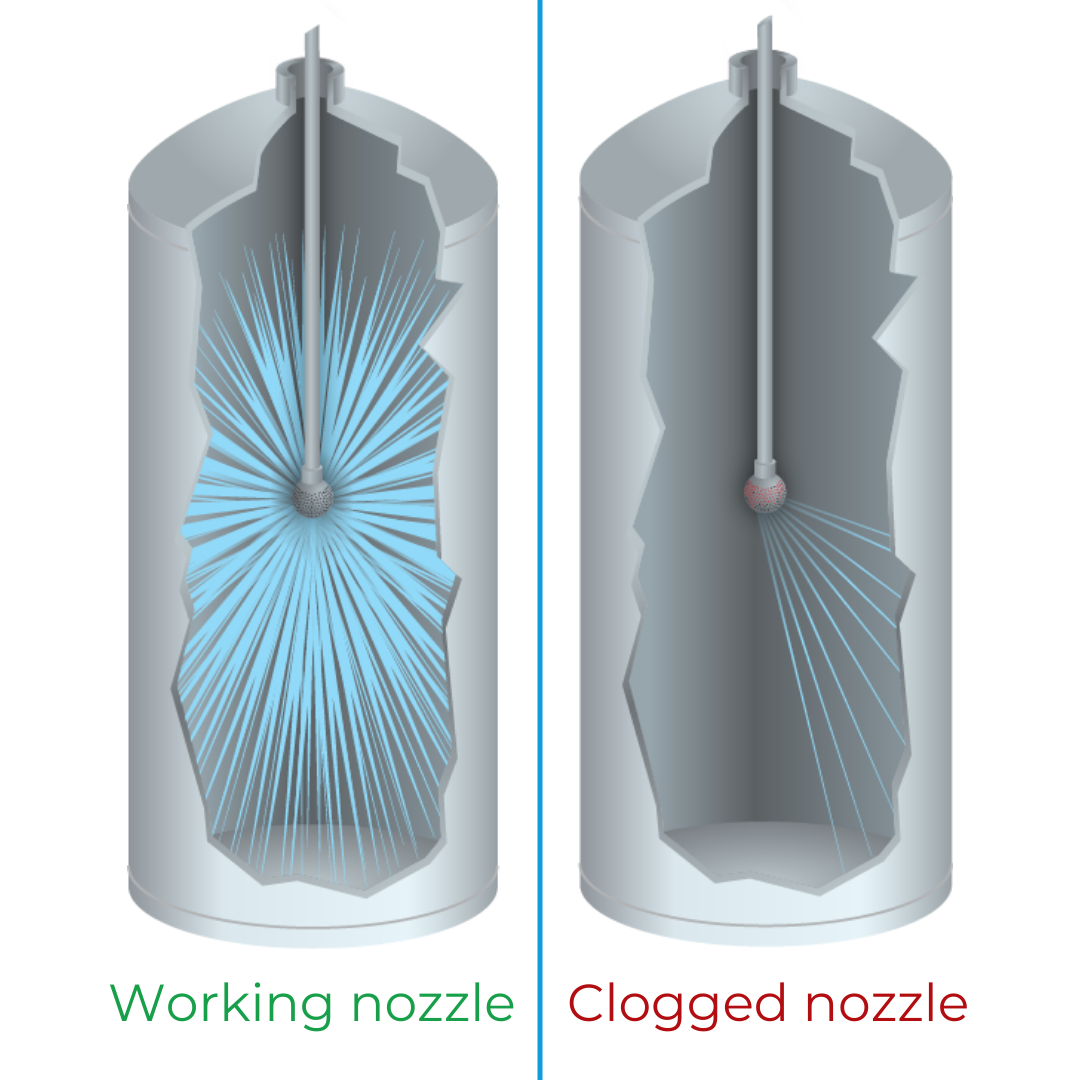
Match the filtration to the nozzle. The smaller the orifice, the finer the filter you need, and that can be much finer than your general plant water supply provides. Hard-water deposits are a common culprit: harmless in most of the plant, but quick to block a spray bar. A fine-mesh filter fitted just before the bar protects the nozzles and avoids unplanned downtime.
5. CAKING
Caking is build up around the nozzle. It is not clogging internally.
The liquid is building up a material externally and the solution to this is anti-bearding or anti-clogging designs that are naturally smooth and don’t have places for that matter to form.
Low adhesive materials such as PTFE can also be used because it is a slippery material that will not present any opportunity for product build up.
Also, regular inspection is very important because in many environments, caking cannot be totally prevented. But by regularly inspecting, removing and replacing the nozzles, caking will be kept to a minimum.
Note the inspection interval here too, and record what you find. If caking builds up faster than expected, the log will show it, and that may point to a change in the fluid or a nozzle design that isn’t suited to the job.
6. MECHANICAL DAMAGE
Mechanical damage often occurs from the over-tightening of threads and nozzles generally will have tapered threads. Tapered threads don't like to be undone and redone up lots and lots of times because they're not designed for that.
They're designed to form a fluid seal and by over-tightening them and taking them on and off regularly, those threads can become damaged which can lead to a leak.
The other big cause of mechanical damage is incorrect cleaning methods. If people are sticking things in the orifice to clean them out or using wire brushes or, heaven forbid, a screwdriver, the orifice of the nozzle can easily become damaged.
The solution: Clean them correctly and treat them with care. Nozzles are delicate components!
Good cleaning is preventative, not something to do only when a problem appears. Use soft brushes or non-metallic tools on the nozzle tip, never sharp objects or wire. For stubborn residue, soak the nozzle in a suitable cleaning solution rather than scraping it. After heavy use, or any change of fluid, flush the system through.
7. POOR FLUID PRESSURE
The fluid supply system cannot maintain the correct pressure that the nozzle needs to see to get the correct flow rate or the correct drop size. The back pressure from the nozzle will drop accordingly and will be spraying at a much lower pressure.
A lower flow rate and bigger drop size may cause all sorts of problems within the system, depending what it is.
The solution: Conduct pressure drop calculations and size the pump correctly to account for them.
8. POOR FLOW RATE
This is slightly different to poor fluid pressure.
A pump that can deliver the correct maximum pressure for example, may not have enough capacity to deliver the correct flow rate. The spray will then generate a back pressure much, much lower which would result in similar types of problem to having a pump that cannot deliver the correct pressure. It'll end up spraying poorly and may splutter.
The solution: Conduct pressure drop calculations and size the pump correctly. The pressure and flow rate of the pump are not the same as the pressure that the nozzle sees. Gravity pressure losses and frictional pressure losses must be conducted.
It's what the nozzle actually sees at the end of the pipe system that's important.
The easiest way to find out what the nozzles actually see is to fit a pressure gauge directly before the spray bar. Most systems already have a gauge near the pump, but that can’t tell you what is happening between the pump and the bar. A gauge at the bar can: if the reading is wrong there, the fault is in the supply system, not the bar or the nozzles. It adds very little cost and can save a lot of diagnosis time. Keep a record of pressure and flow readings too, because small changes that persist often point to a developing problem such as a partial clog, a leak or a tiring pump.
9. POORLY ALIGNED NOZZLES
Perhaps the nozzles are getting bashed and misaligned or threaded in incorrectly. This can cause the spray to go in the wrong direction.
The solution: Align them properly.
If the nozzles become unaligned for no obvious reason, adjustable nozzle holders allow an easy realignment of the nozzle without having to toil with the pipework.
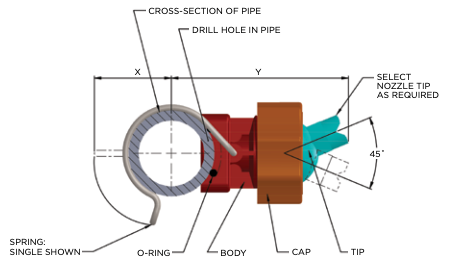
Dove tail nozzles are also a suitable solution; rather than having a thread, these nozzles have a dove tale connection and will slot in the correct orientation in a spray bar for example. Flat fan nozzles only spray correctly when they are oriented correctly, and threaded fittings can wear and drift over time. Self-aligning fittings, such as dovetail or bayonet connectors, fix the orientation every time and make nozzle removal quick, which helps during changeovers as well as fault-finding.
Conclusion
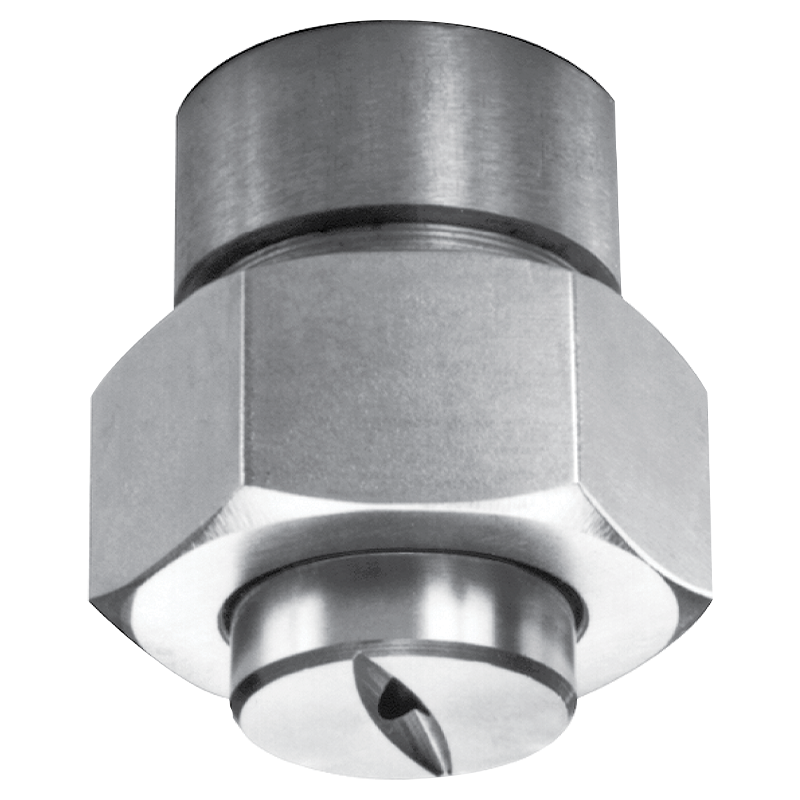
Those are common causes of spray problems with spray nozzles and the potential solutions. Nozzles are inexpensive wear parts, and whichever of the problems above you’re dealing with, replacement is often part of the fix. Unused nozzles store well for years, so it makes sense to hold a full spare set. Many nozzles are made to order, so waiting for a replacement can stop a line for far longer than the nozzle is worth. Ordering replacements before the old ones become completely ineffective means a changeover takes minutes, not days.
Please don’t hesitate to get in touch with one of our friendly spray nozzle experts for any further advice and solutions.